How a Thermal Airship Keeps Its Tail Up
Published 07/10/2024, last edited 12/10/2024
Contents
1 Introduction
On 23 January 2022, I witnessed a thermal airship fly over the Cardington sheds.[1][1]: Cardington is a small village south of Bedford, England, and is the birthplace of British airships. Its two characteristic green sheds, which once housed the R101, are standing there to this day. Incidentally, a newer village named Shortstown today is much closer to the sheds than Cardington (with its newest housing development having extended to the very edge of the northern shed). I had not seen a thermal airship before that date, and perhaps didn’t even know of their existence.[2][2]: On second thought, I do remember a thermal airship (or an airship caravan) being featured in a Top Gear episode I had watched. See this video and this webpage for information on the making of this thermal airship caravan.
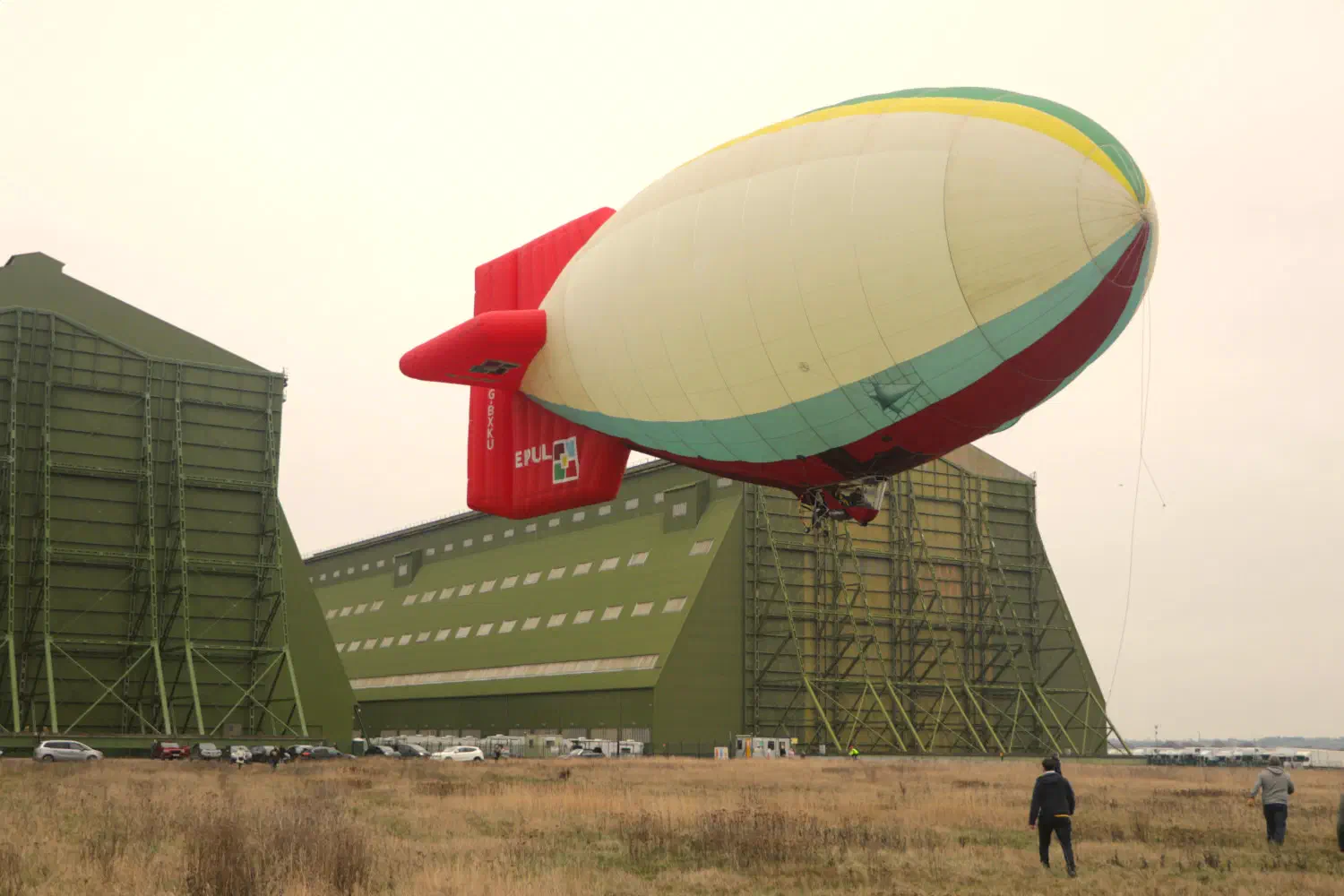
Once the thermal airship had landed, I got to inspect it more closely. A thermal airship’s pilot has three control variables at their disposal. Rudder deflection control, engine power setting, and whether or not the burner is on. The rudder controls the direction, the engine power the speed, and the burner the altitude. No pitch control is needed as the thermal airship is stable in pitch (at least up to the airspeeds that its small engine will allow) and altitude is controlled with the burner. Despite being much less maneuverable than a regular airship, a thermal airship does have one feature not available on regular airships: variable buoyancy control. A regular airship’s buoyant lift is constant (it does vary to an extent as a function of superheat, but this cannot be controlled by the pilot). The thermal airship pilot, on the other hand, can vary the buoyanyt lift of his craft using the burner, although the rate at which buoyant lift can be reduced is limited and depends on the amount of heat transfer between the hot air in the hull and the outside air. While this may seem like an advantage, it is noteworthy that this is extremely energy-inefficient. The thermal airship had two large propane gas tanks, which only last for around 45 mins, making thermal airships one of the least energy-efficient modes of transport — and this is just to keep it in the air! The engine still needs a separate petrol tank to provide propulsion.
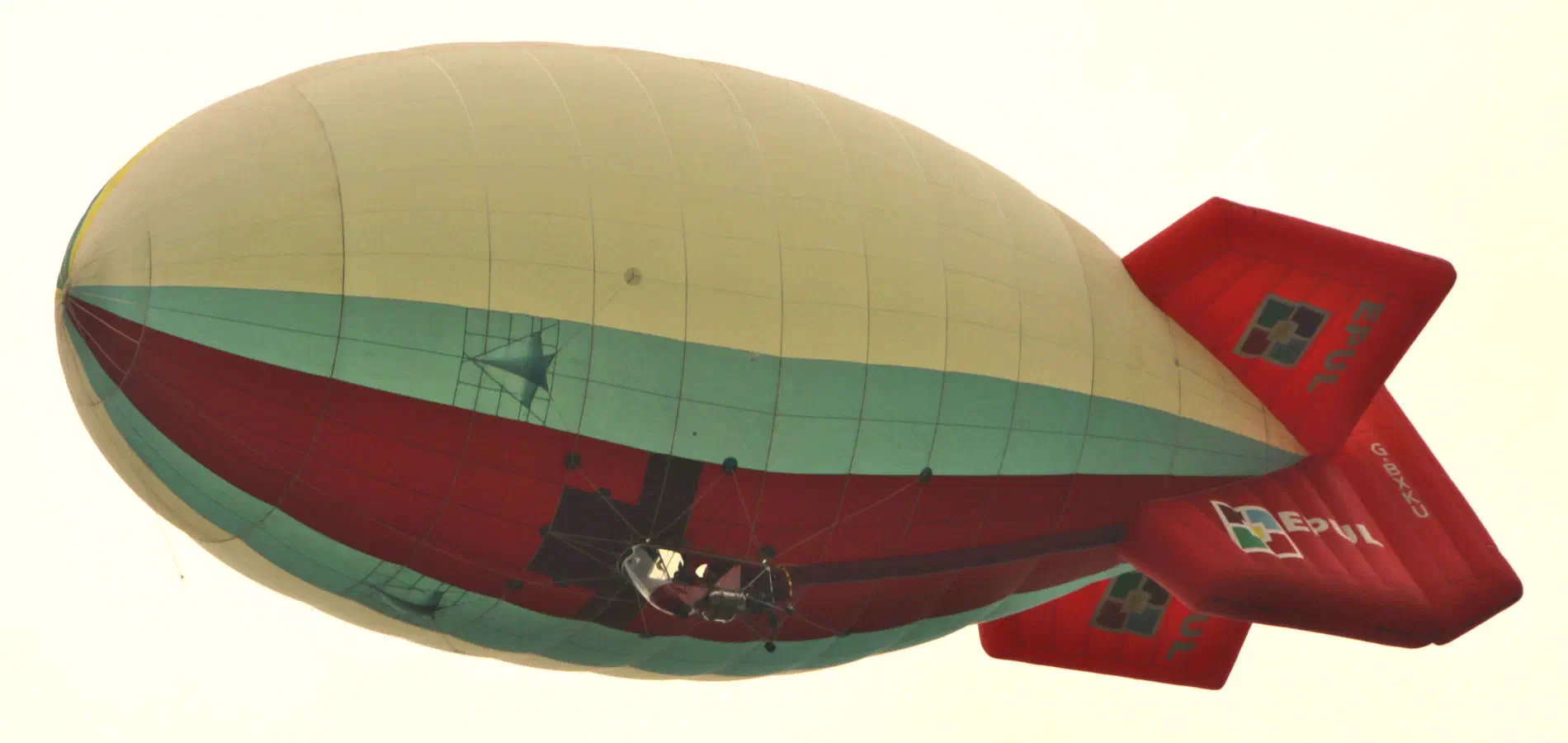
To accommodate the burner and to allow the volume of air in the hull to vary, a thermal airship has a big hole in its hull, at the bottom just above the pilot’s seat. Due to this hole, a thermal airship’s hull cannot be pressurised.[3][3]: Note that during inflation, the tail surfaces are pressurised separately with an air pump after the hull is inflated via the burner. One might therefore wonder how it is possible for the thermal airship’s tail to remain upright and for its hull to appear pressurised.
2 Explanation
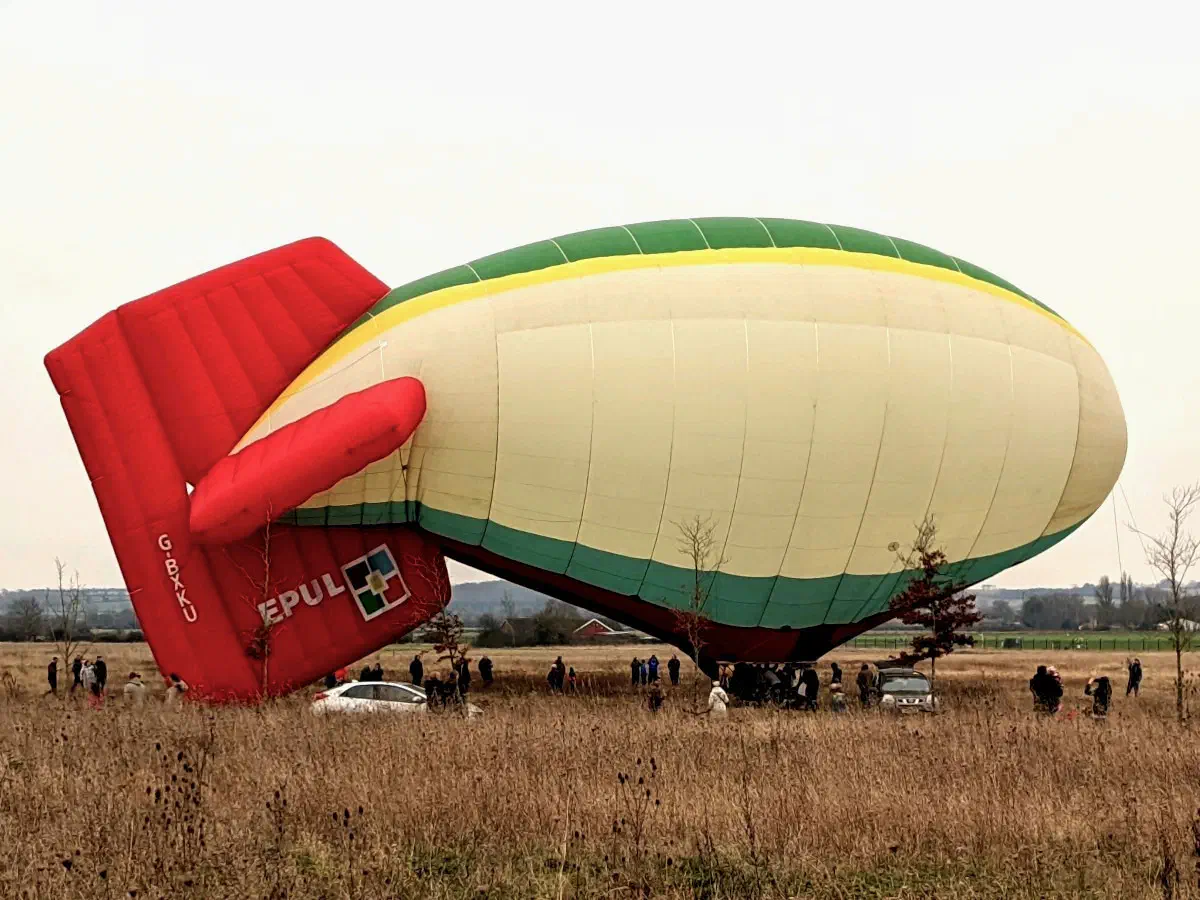
At the bottom of the hull, the pressures inside and outside of the hull are equal (if this wasn’t the case, pressures would equalise via the large hole in the bottom of the hull). At any point above the bottom hole, however, pressures inside and outside need not be equal. We can calculate the respective pressure at any point inside of the hull by integrating the pressure gradient vertically, where is measured vertically upwards and has its datum at the bottom of the hull, where the hole is located: (1)For the vertical pressure gradient we may write (2)keeping in mind that the likely non-uniform temperature in the hull may be a function of , and hotter air will accumulate at the top of the hull, as a consequence of which the density is also a function of . For the pressure outside of the hull, on the other hand, we have simply (3)[4]: At these vertical scales, we can consider the outside air density constant.Therefore, for the pressure difference (4)Since the air inside of the hull is warmer and so , there is a positive pressure difference across the hull for . This pressure difference is preventing the tail from drooping down.[5][5]: If the air inside of the hull is too cold, the difference in densities will be smaller, and as a result the pressure difference is too small to keep the tail upright — see Fig. 3. For this reason, a thermal airship must also have a small fineness ratio, to ensure that there is a sufficient height difference between the bottom of the hull, where pressures are equal, and the tail, where they mustn’t be.[6][6]: This also implies that a thermal airship cannot pitch up too much, as this would reduce the vertical distance between the bottom of the hull and the tail. This isn’t much of a concern, however, as a thermal airship lacks pitch control and stays approximately level during flight. This is not the only reason for having a low fineness ratio, however. Due to the relatively high density of the lifting gas, a large hull volume is needed to carry a comparatively small load.[7][7]: This thermal airship had a volume of or and was only able to carry two persons plus fuel. A lower fineness ratio allows a decrease of hull length for a given volume. Most importantly, however, a low fineness ratio minimises hull fabric stresses as a result of bending loads. Larger bending moments necessitate higher hull pressures to keep the hull fabric in tension everywhere. A thermal airship, owing to being unpressurised, simply wouldn’t be able to provide those hull pressures.