Curiosities from the Eurobike 2025
Published 20/07/2025, last edited 15/08/2025
Contents
1 Introduction

This year I went to the Eurobike[1][1]: The Eurobike is the world’s biggest bicycle trade fair. Apart from bicycles, a potpourri of cargo bikes and various other types of human powered vehicles (and also some purely electric light vehicles) may be inspected by the keen visitor. for the third time (I had previously gone in 2022 and 2023, but not 2024). As before, I really enjoyed seeing all the latest developments from the bicycle world. I am also a great fan of the Eurobike’s test track, where visitors are able to test out various human powered vehicles.
Unlike most news articles reporting on the Eurobike, this piece does not report on Shimano’s latest supposedly AI-powered gear shifter, the latest E-MTBs, or gravel bike trends. Those things are incremental developments at best, and marketing nonsense at worst. I’ve also found that larger businesses often loose their ability to innovate. The real treasures therefore tend to be hidden in some of the smaller booths, of which there are some 1,500 at the Eurobike.
I do not claim to present an exhaustive list of interesting innovations from the Eurobike. I was only there for two days, and while I walked past every booth at least once, I cannot possibly claim to have seen every noteworthy innovation. With the number of booths and products presented at the Eurobike, a thorough inspection would take months. That being said, I hope to present some interesting developments that the major news publications likely missed out on. Some of the products I discuss in this article have been at the Eurobike previously, but I haven’t had a chance to write about them thus far. The article is therefore not just a report of new innovations, but rather a collection of my thoughts on products that I saw at the Eurobike 2025.
I am placing my focus on items I find particularly exciting. Namely:
- folding bikes,
- light electric vehicles and velomobiles,
- drive systems, gear boxes, and other innovative components,
- and miscellaneous.
As usual, I found hall 8.0 the most interesting. This is where the start-up and cargo areas are located, as well as various ecomobility solutions. The Eurobike Award exhibition can also be found there.
Thanks to Marcel Smelt from Coffee on Wheels at the Continental stand for providing me with a great cappuccino each morning!
2 Folding bikes
2.1 Chedech
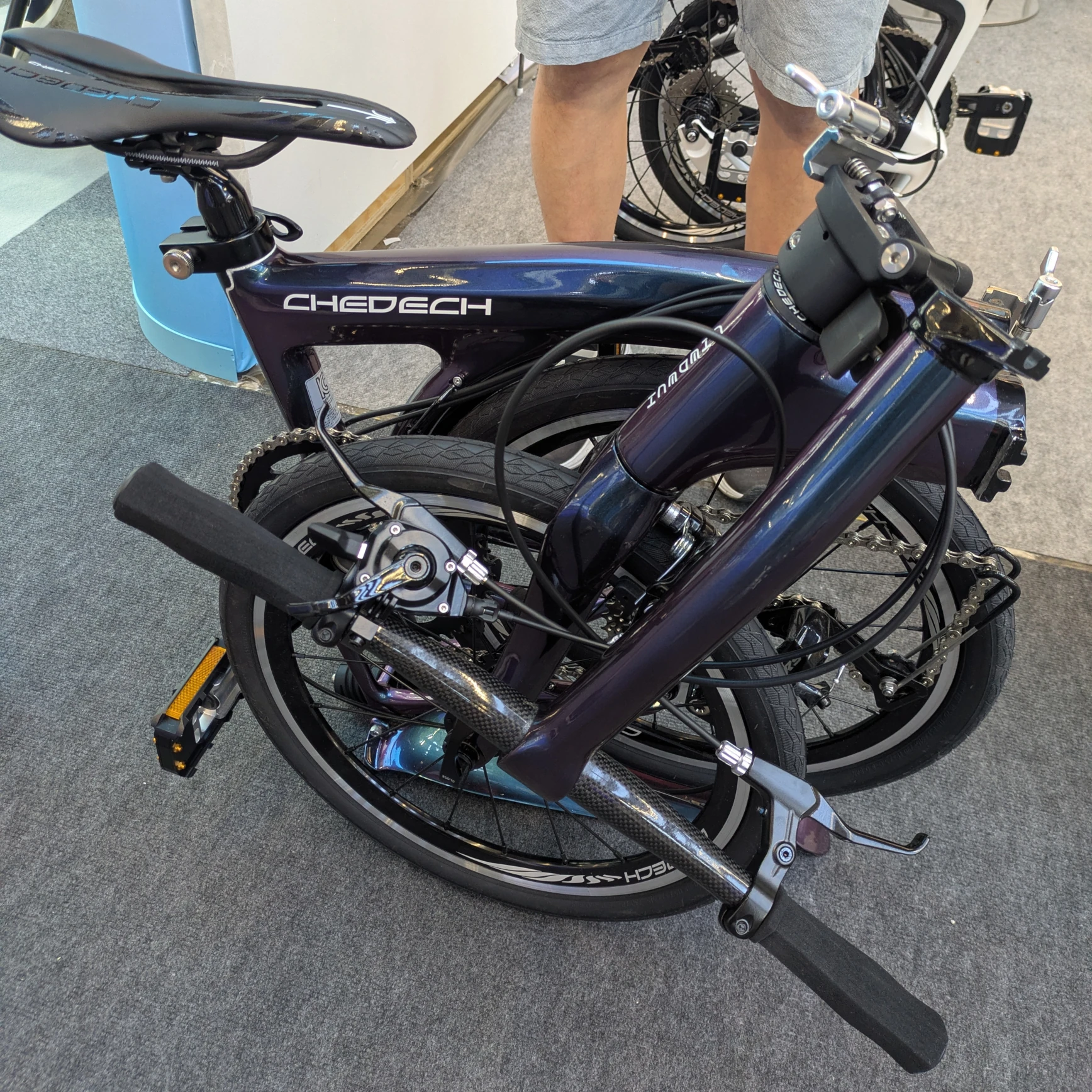
Chedech is a South Korean folding bike manufacturer, who I first encountered at the Eurobike 2023 (though different variants of this folding bike appear to have been around for almost 10 years). Some might call it a carbon (fibre) copy of the Brompton. It features the same trifold mechanism, but that’s where the similarities end. The frame is made of CFRP, making it very light (the 6-speed derailleur version weighs just 8.6 kg). It features 18 inch instead of 16 inch wheels, however that is an entirely academic distinction as the Brompton’s 16” wheel has an ERD of 349mm, and the Chedech’s 18” wheel an ERD of 355mm, a difference that is not visible to the naked eye.[2][2]: I think the difference in wheel size is actually more of a disadvantage, as it reduces the available tyre selection (tyre manufacturers have adjusted to the popularity of the Brompton by widening their 16” offerings). The Chedech’s hinge clamps have a quick release mechanism rather than the threaded clamps the Brompton uses, which makes the bike significantly quicker to fold and unfold. The Chedech’s rack is a bit pointless, as it neither features an attachment mechanism for cargo, nor contains rollers. Its shape also has somewhat of an unconventional aesthetic.
Having ridden a demo bike, the frame appears to be significantly more flexible than the Brompton’s. There also appears to be a little bit of play in the hinge clamps (though this isn’t really noticeable while riding). The latter issue could potentially be resolved by tightening the frame quick release mechanism (though that isn’t as straightforward as it might seem).
Chedech was sued by Brompton in Belgium in 2017 for copyright infringement. The patent for the trifold mechanism had long expired at this point, so Brompton wasn’t able to sue for patent infringement. I am not well versed in matters of copyright, but it appears in Belgium the multiplicity of shapes theory applies, according to which a shape is not considered necessary to achieve a technical result if there is proof that other shapes are able to achieve the same result. To enjoy copyright protection, it is therefore sufficient to prove that multiple shapes are possible to achieve a technical result. The Belgian court was unsure whether this theory complied with EU law, and referred the matter to the Court of Justice of the European Union, which in 2020 rejected the multiplicity of shapes theory and ruled that copyright can protect a product’s shape which is, at lest in part, necessary to obtain a technical result, provided the design leaves the author scope for creative expression (originality). According to the ruling, a shape solely dictated by function cannot enjoy copyright protection.[3][3]: An interesting legal analysis of the ruling may be found in this article, if you are into that sort of thing. At the point of the CJEU’s ruling, several media publications reported this as a win for Brompton, even though the Belgian court’s ruling, which found in favour of Chedech, only came a year later.[4][4]: In fact, the only publication I was able to find that reported on Chedech’s win is this French article. Brompton later appealed, but subsequently lost again.
2.2 Sharvan
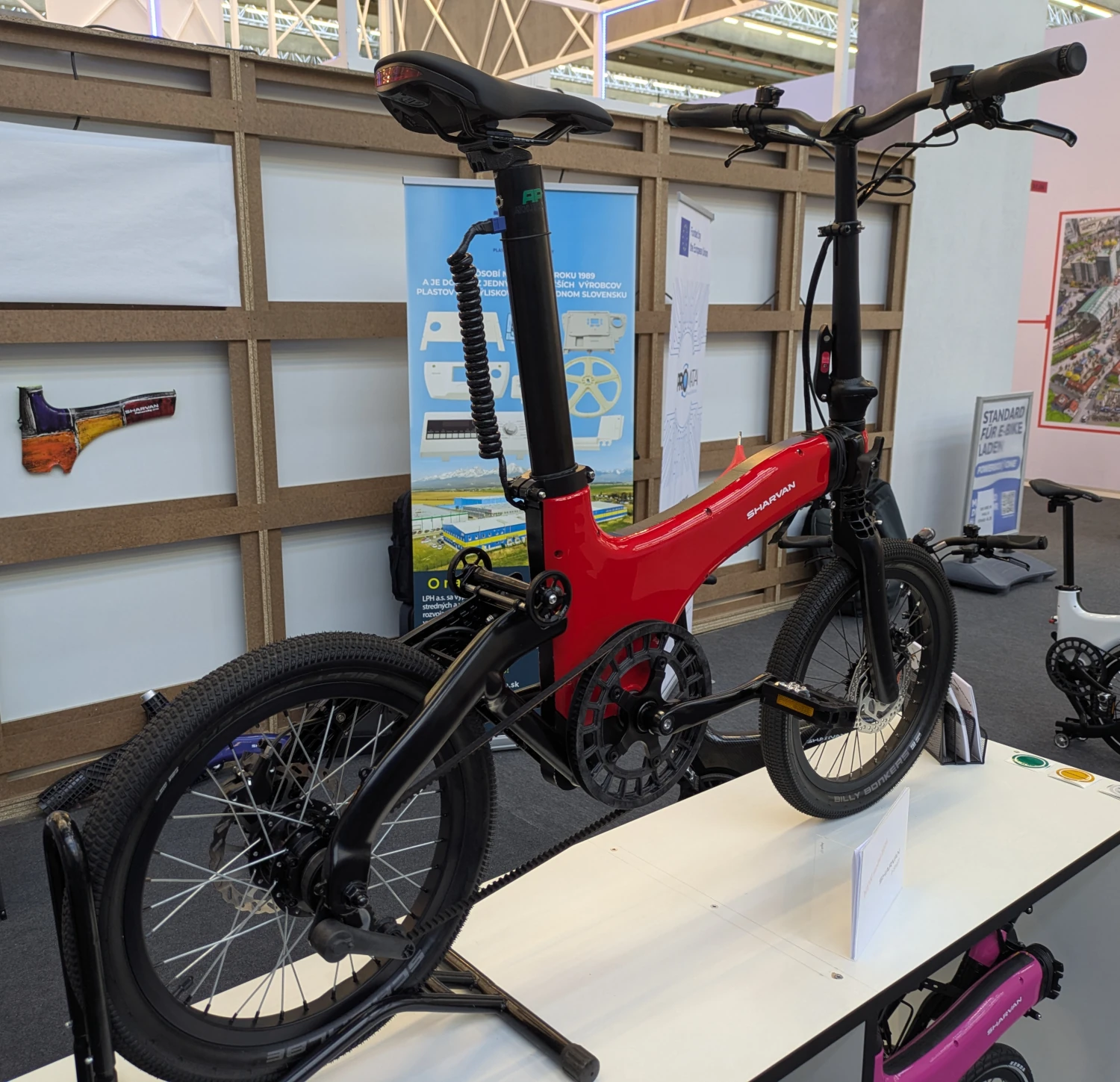
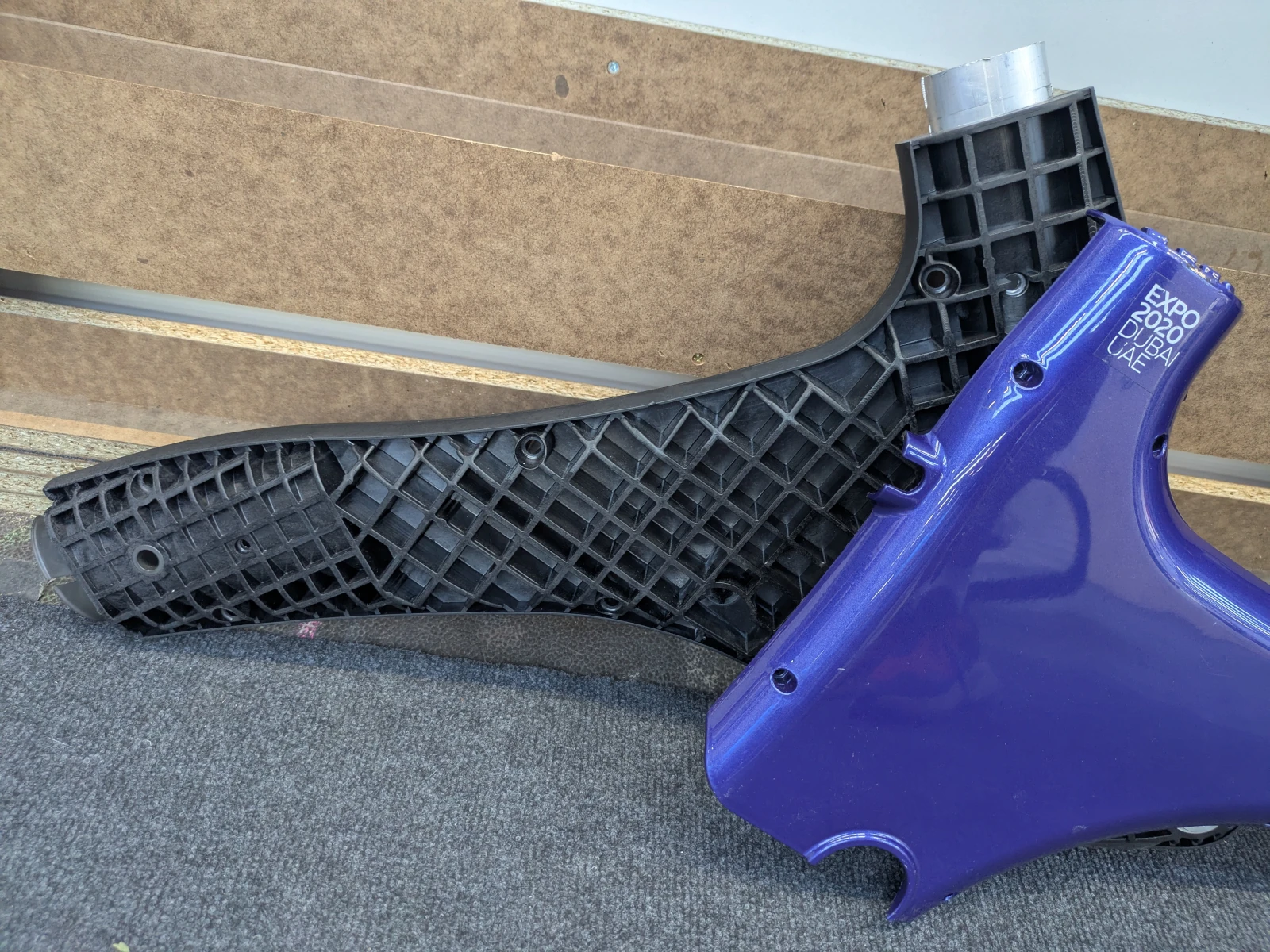
The Sharvan folding bike is manufactured in Slovakia by LPH Group, a manufacturing business specialising in plastic parts and injection moulding. Its aesthetic reminds me of the Hummingbird[5][5]: Now seemingly renamed to Prodrive folding bike.. It is noteworthy because it uses an injection moulded frame (see Fig. 3(b)). The material used is polyamide with carbon fibres mixed in. While this is undoubtedly very cheap to manufacture, the frame was rather heavy (though I forgot to ask the exact weight). The frame also features an interesting length adjustment mechanism (see Fig. 4), which is actuated using an Allen key. I imagine that this is to allow people of vastly different height to use the same bike, after some adjustment (on the website, a rider height range of 120 – 205 cm is listed).
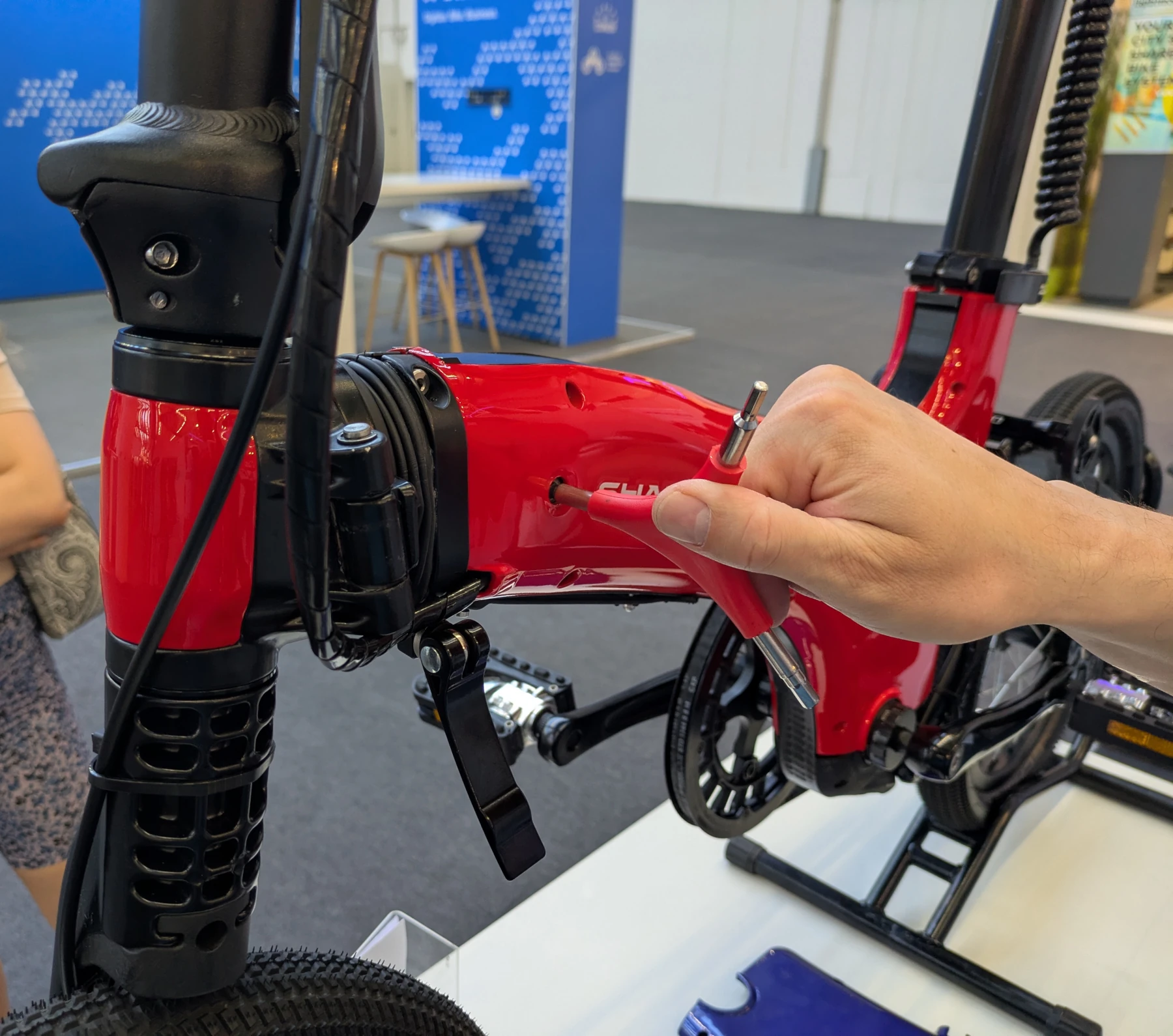
Perhaps the designers realised that a purely injection moulded frame would be too heavy, so the latest version of the Sharvan features an aluminium centre piece (see Fig. 4).
2.3 The Urban Bike Foldy
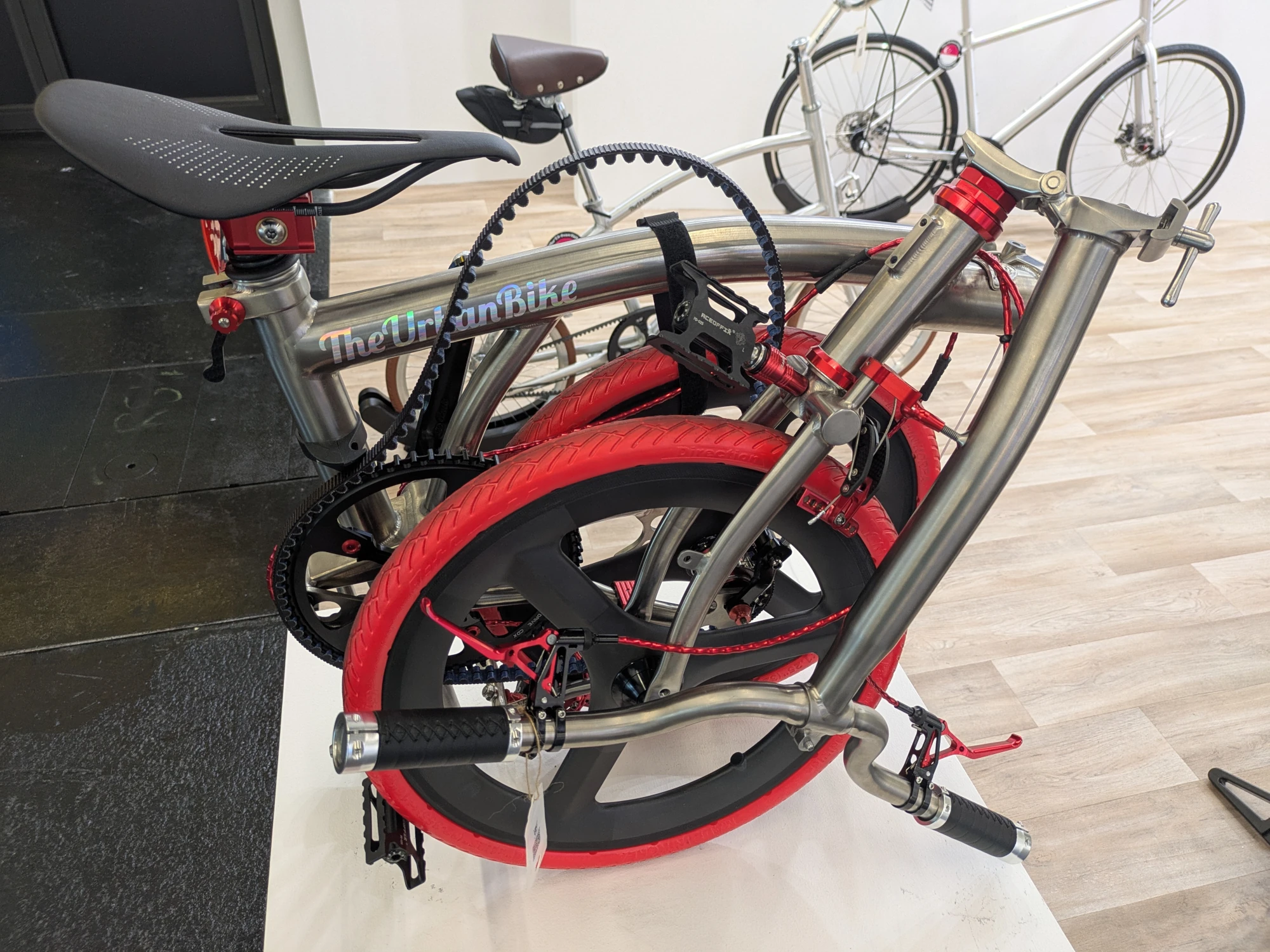
The Urban Bike is a Singaporean brand founded in 2011 specialising in belt driven bicycles. The Foldy is a trifold folding bike and was on the Eurobike for the first time in 2025. It is made of titanium, costs around €4,000, and weighs only 6.9kg! This bike’s most significant innovation is the belt drive. While it isn’t the first folding bike with a belt, it is the first commercially available belt driven trifold folding bike I have seen[6][6]: Kinetics have sold a Brompton belt drive upgrade kit for a while.. Because the distance between the rear wheel axle and the crank decreases when the bike is folded, the belt is slack in the folded state. To prevent it from falling off, a small plastic hook mounted on the seat tube acts as a retainer for the front sprocket, and a circular retainer does the same for the rear sprocket.[7][7]: The Kinetics belt drive kit keeps the belt taught during folding with a sufficiently long belt tensioner, and folds the belt back on itself, something one is apparently not supposed to do with a belt. The Hummingbird/Prodrive folding bike doesn’t suffer this issue, because the rear wheel’s folding axis coincides with the bottom bracket — an elegant solution, however this results in a less compact fold.
The Foldy’s frame is manufactured in China. China seems to be the only place where it is still possible to manufacture titanium frames economically, due to the availability of titanium.
2.4 Java
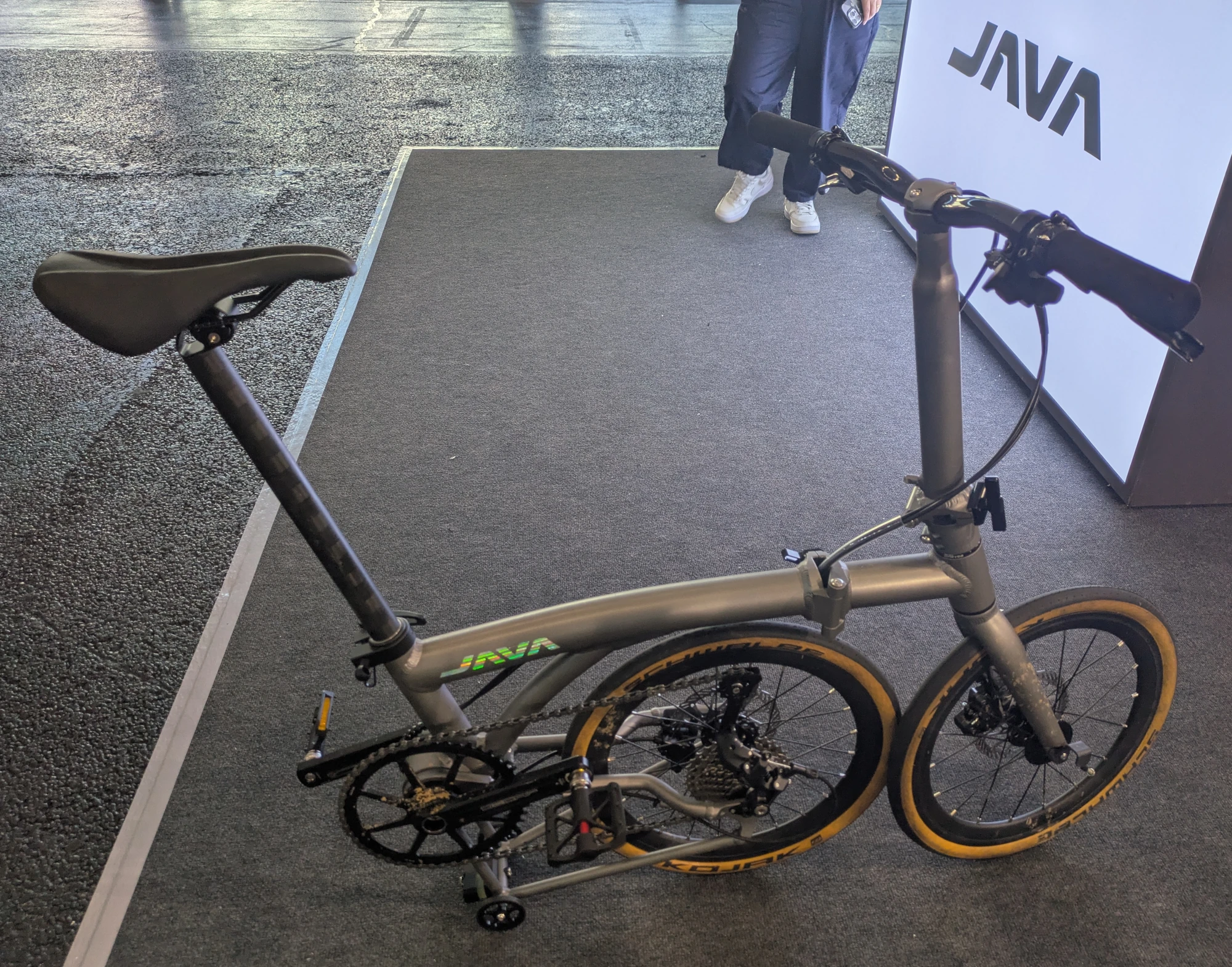
The Java folding bike is a new product that was shown on the Eurobike 2025 for the first time. Java seems to be a Chinese brand, but I wasn’t able to find anything about it online (and I forgot to ask…). It is still a prototype, and the manufacturer couldn’t tell me its weight! It features a trifold mechanism with disc brakes. Particularly noteworthy is the cable routing, which is partially internal, something I haven’t seen on a folding bike before.
2.5 Iruka folding bike

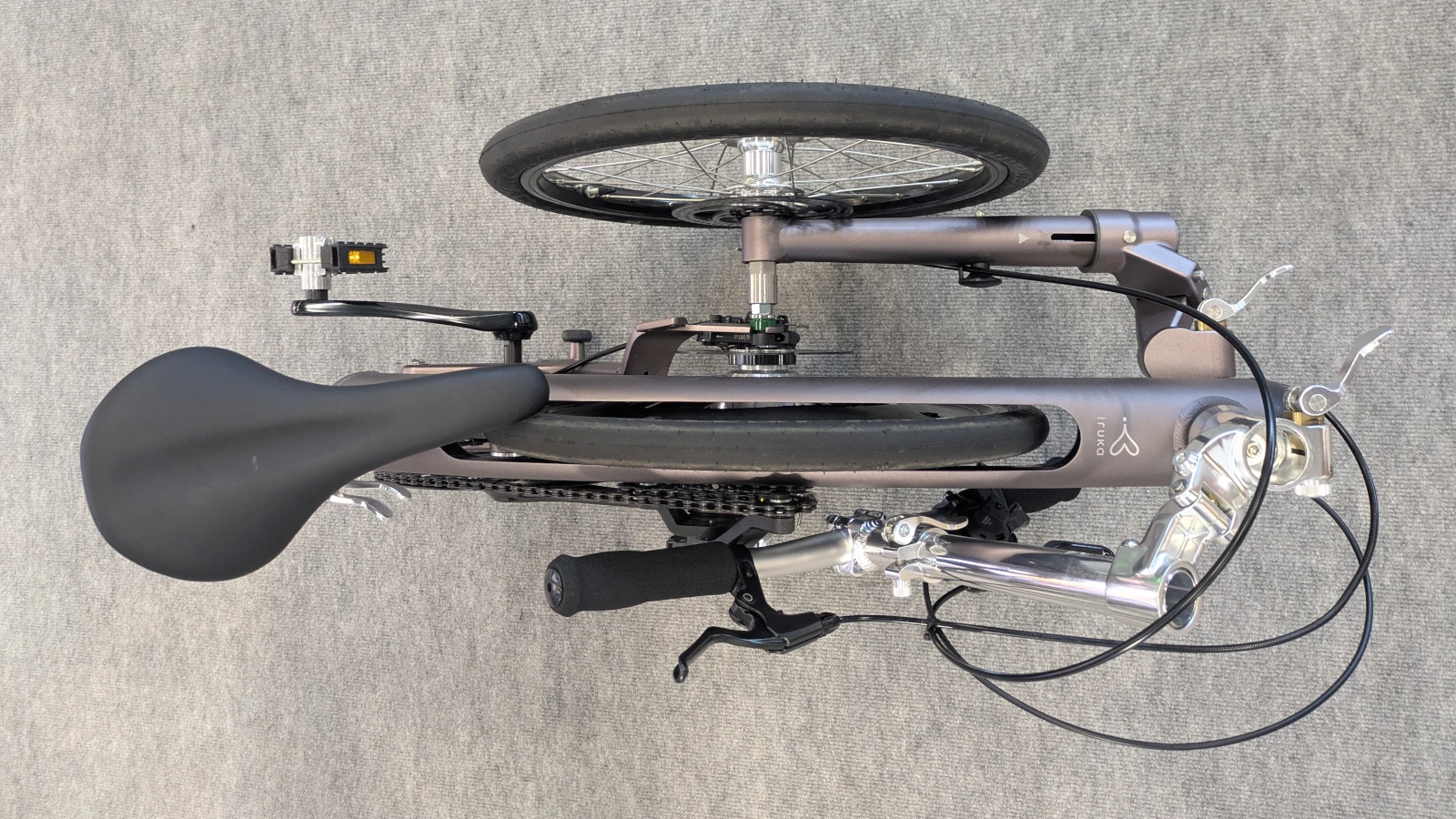
The Iruka is a folding bike design from Tokyo, Japan. I found it noteworthy because of the slit in its frame, which accommodates the rear wheel in the folded state.
2.6 Rubus folding bike

The Rubus is a new Chinese electric folding bike with an innovative design. It has an interesting folding mechanism which automatically retracts the seat post during the fold. The manufacturing of the bike is also very interesting. The aluminium frame has no welds, instead all parts are die cast! The required hardened steel moulds present a high upfront cost, but should enable very economic volume manufacturing. Having ridden the bike, the rear hub motor is very quiet and rather powerful. However, the frame is quite heavy. Furthermore, to sell in Western markets, some of the low-end components (such as the Shimano Altus derailleur) may need to be replaced with higher end ones.
2.7 Mikalon
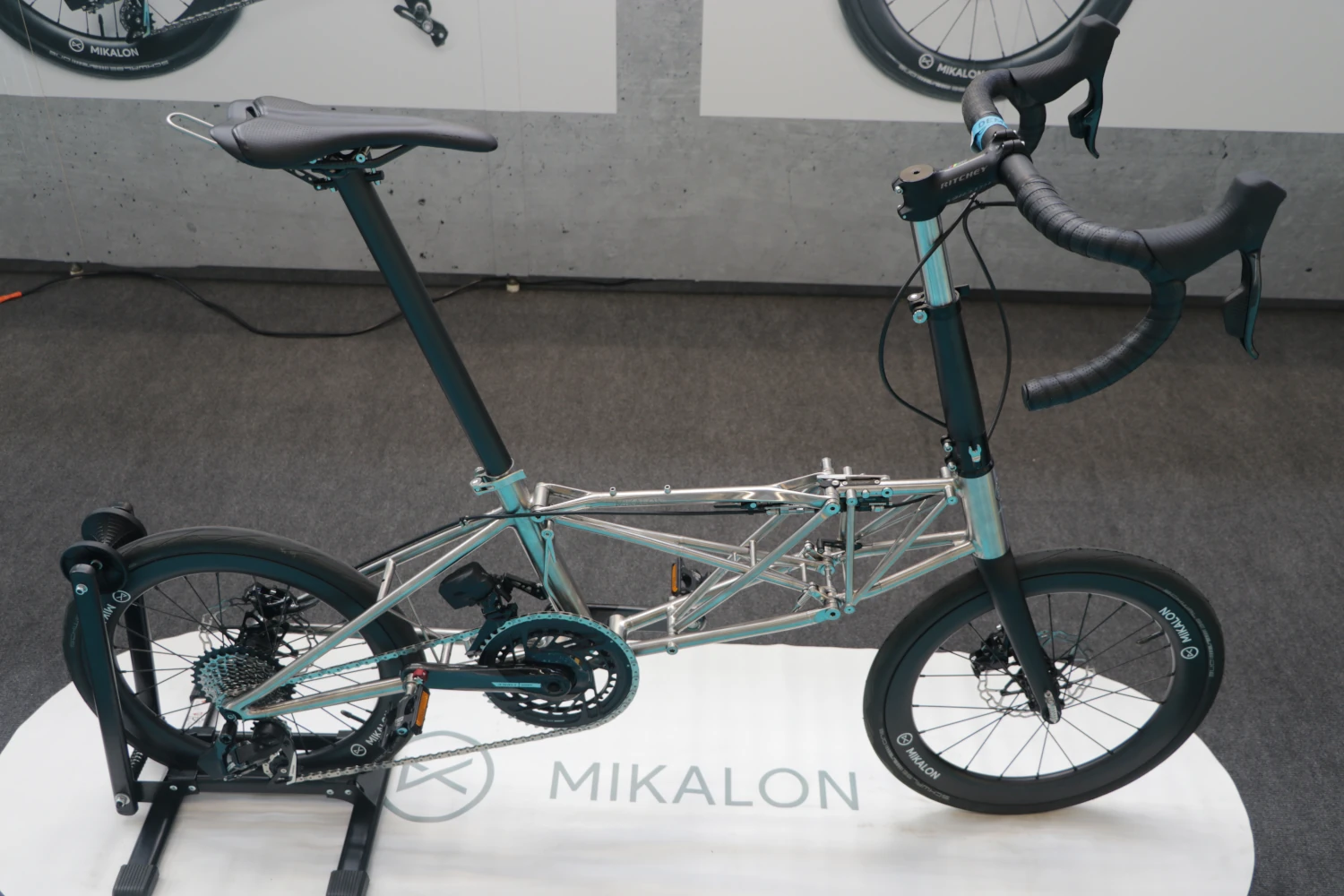
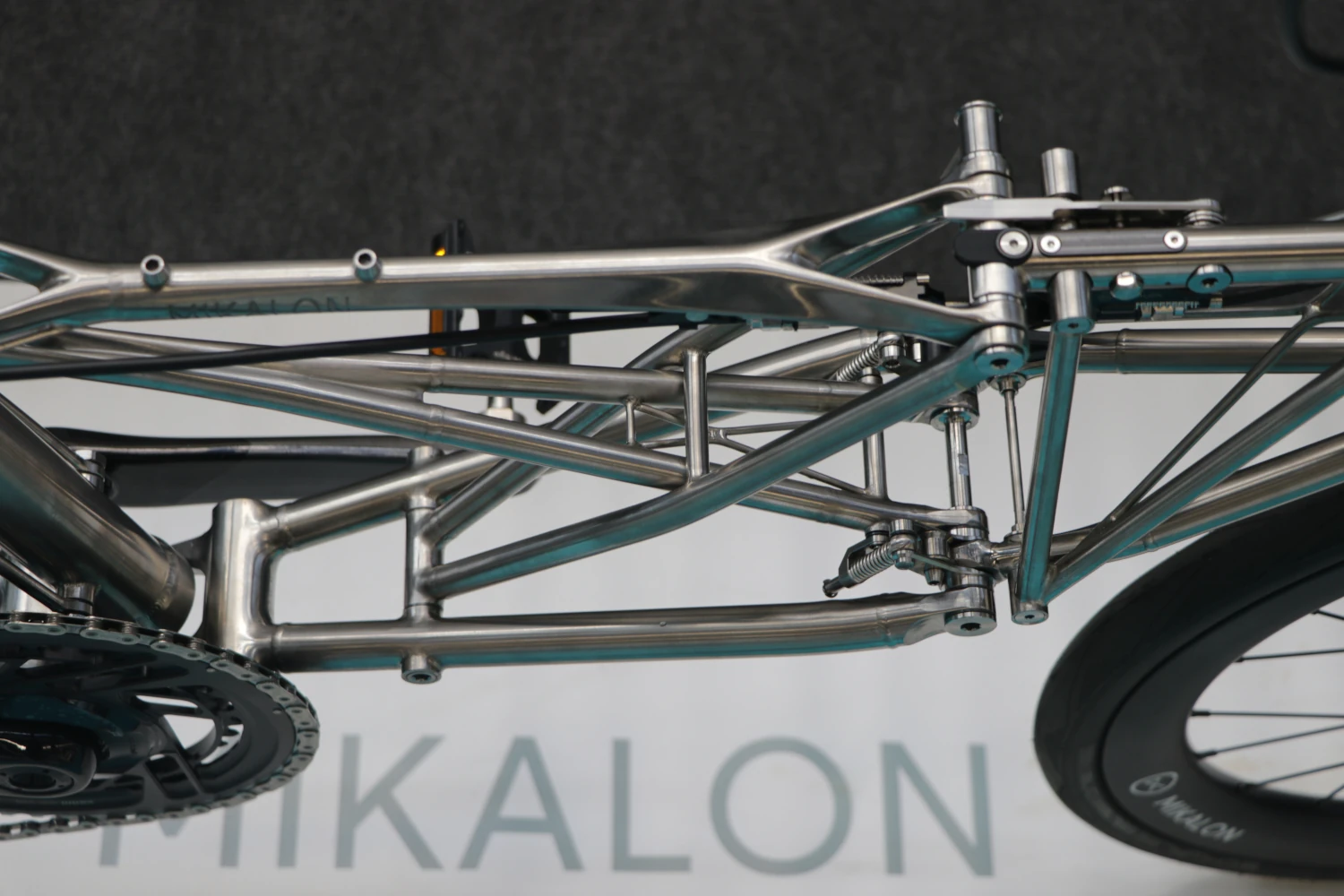
The Mikalon is an interesting new bicycle design from South Korea, designed by architect Il Hoon Roh. It is a hybrid between a folding and a separable bike. Its beautifully intricate frame design reminds me of the Moulton, though the Mikalon is significantly more intricate. Unlike the Moulton, it stays in a neat package when disassembled and folded, and can be wheeled in the folded state. The folding process is rather involved — you can watch a video of it here. The bike is manufactured from titanium with some carbon parts. I haven’t found a price tag for it yet, but given the intricate frame design and the choice of materials, the manufacturing cost must be eyewatering.
2.8 biQe
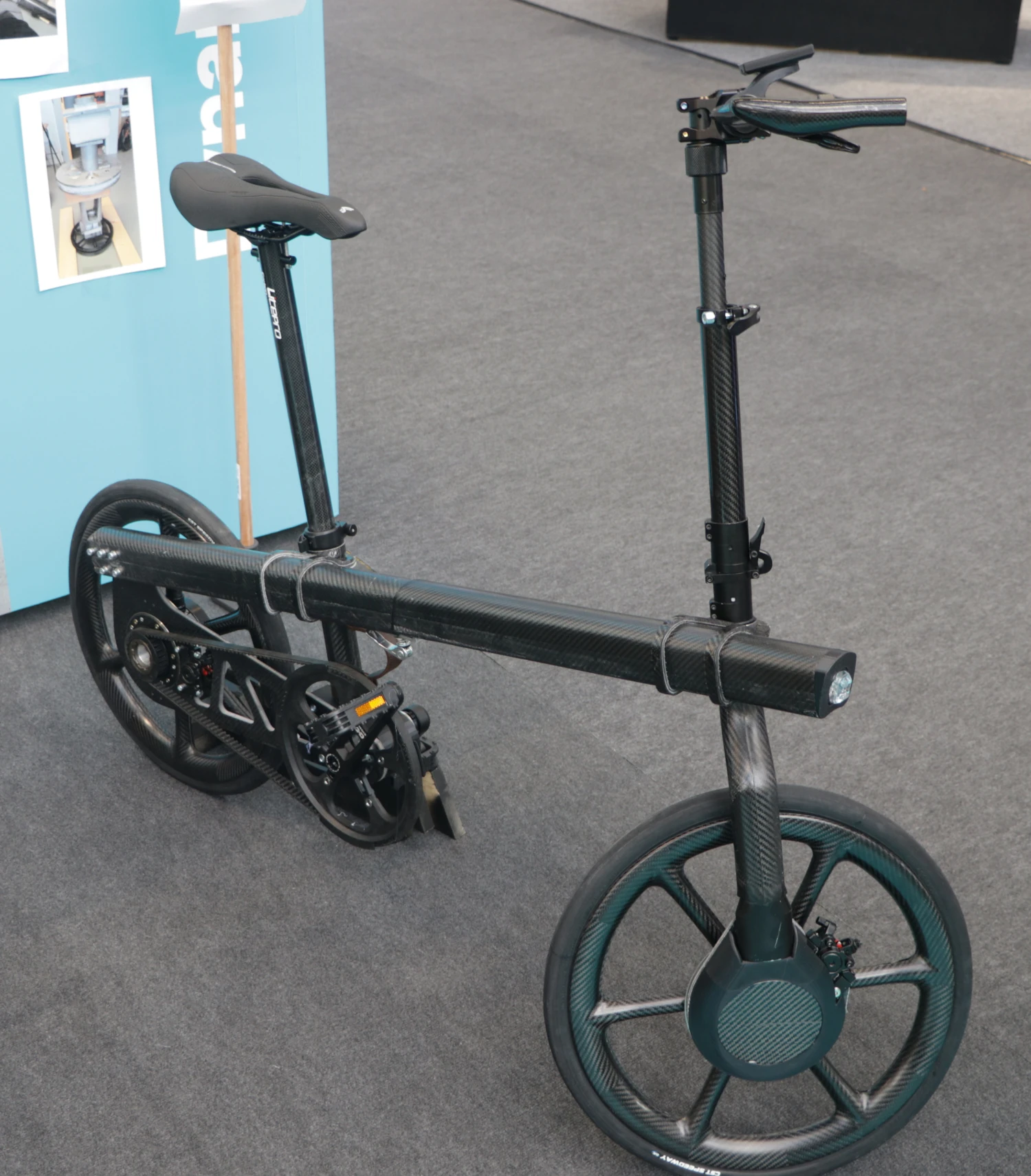
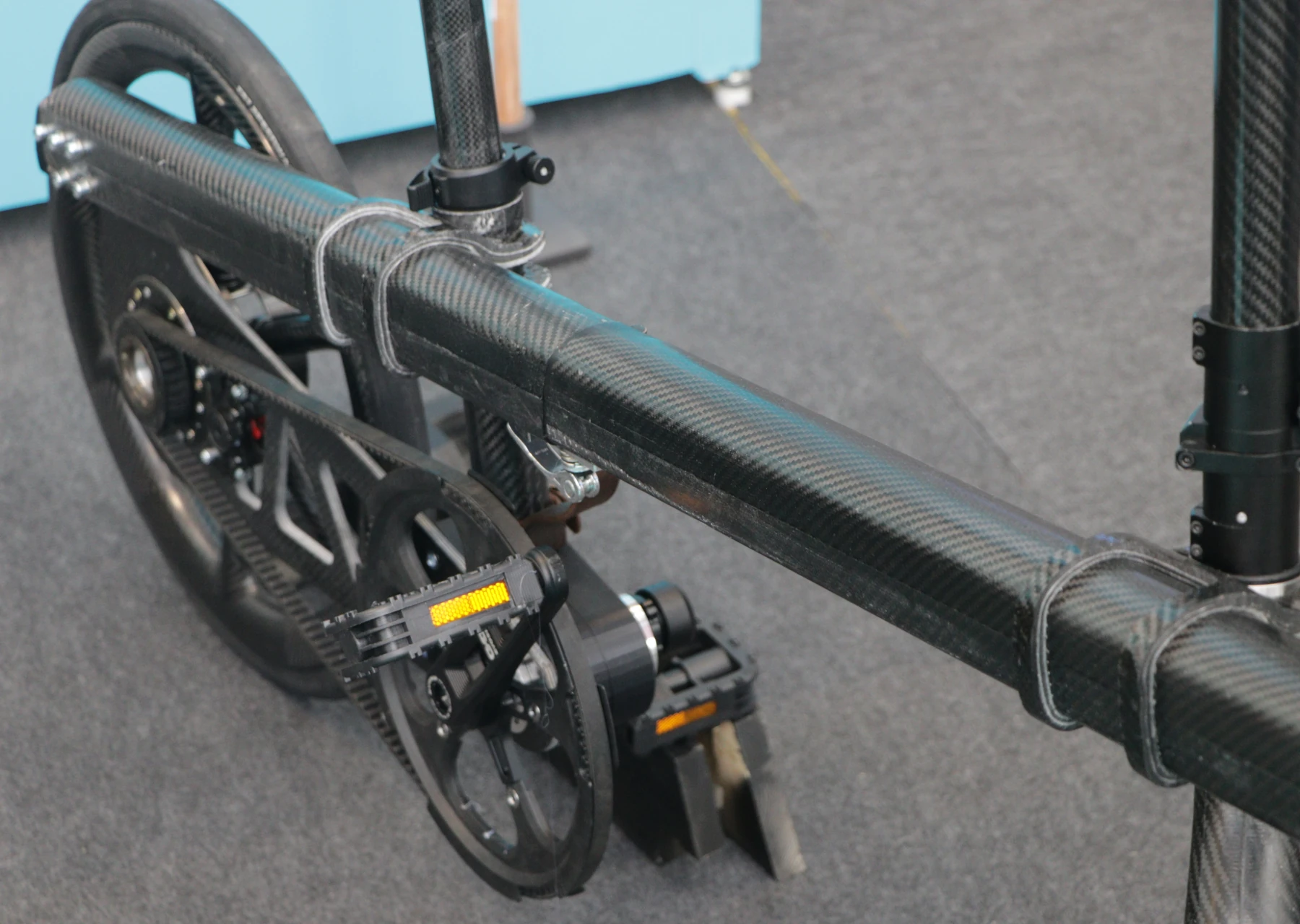
The biQe is a startup product designed by Gokhan Ceterez, a Turkish gentleman who moved to the Netherlands to pursue his folding bike dream. The bike is almost entirely made of carbon fibre and weighs in at just 7.9 kg, despite its 20” wheels. Most impressive is perhaps the price tag of €990. It remains to be seen whether the folding hinge, located in the middle of the frame, will stand the test of time. Unfortunately, I didn’t take a picture of it in the folded state, however you can find one on the biQe’s website.
2.9 Gogobike
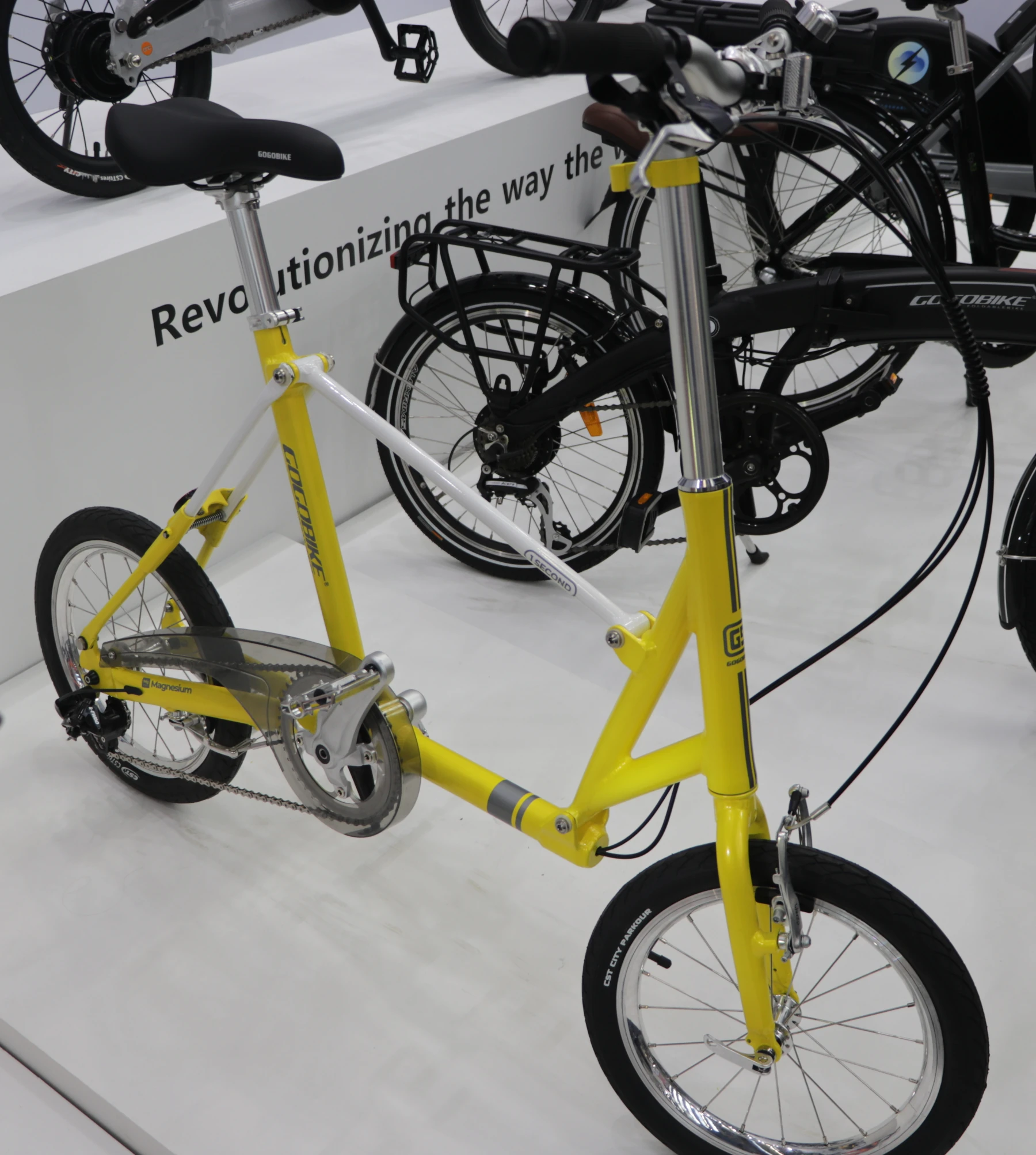
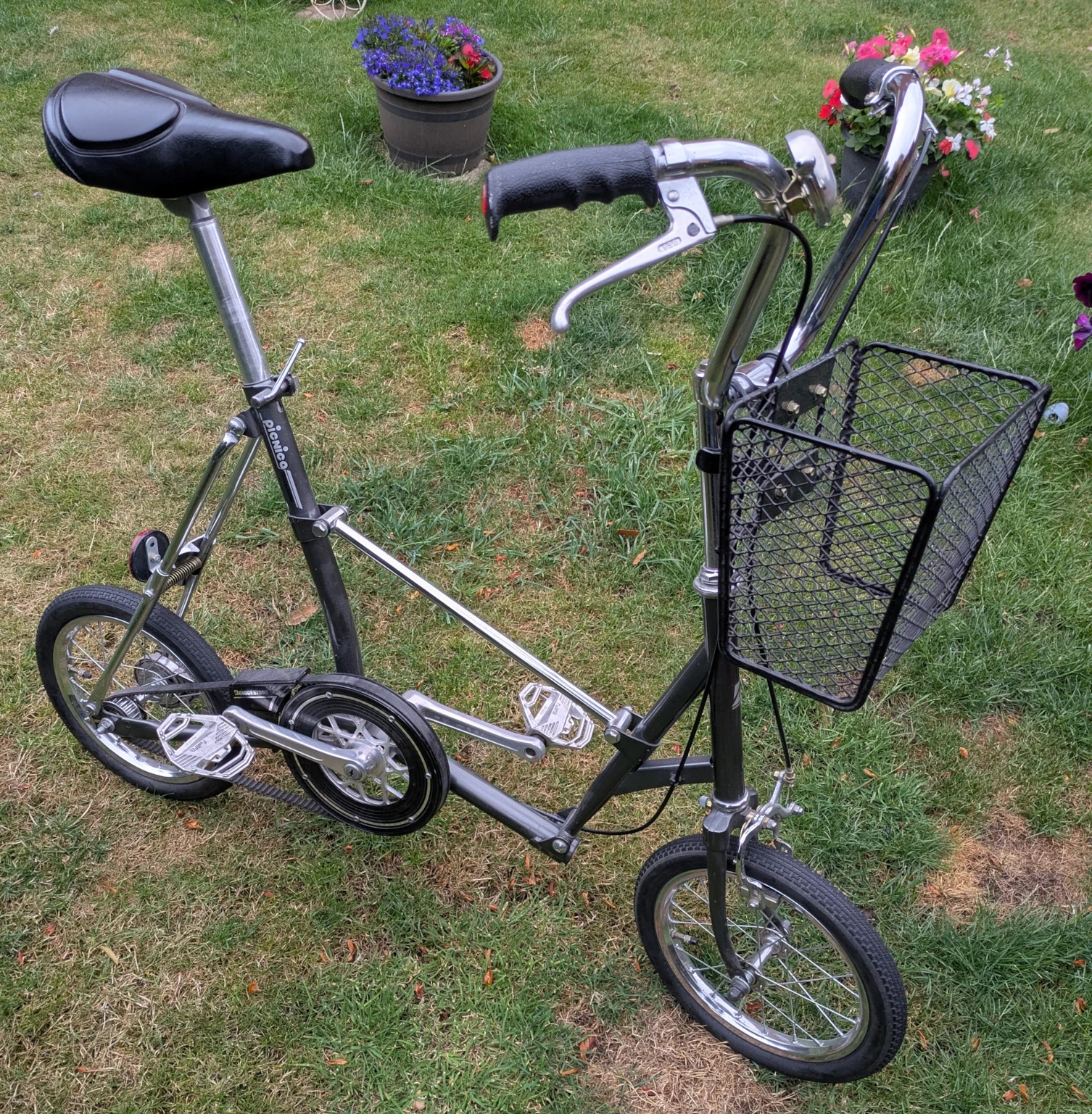
This bike is noteworthy for two reasons. Firstly, its folding mechanism is that of the Bridgestone Picnica (though the seller claimed they developed it). Secondly, the frame is apparently made of magnesium alloy, a material rarely used for bicycle frames. While magnesium alloy has greater specific strength than aluminium alloy and therefore results in a lighter frame, it is harder to weld, has poor ductility, and is more susceptible to corrosion.
Unlike the Bridgestone Picnica, the Gogobike features a chain rather than a belt, an unfortunate regression.
While the folding process basically consists of one step and is therefore very quick, the bike isn’t that much smaller when folded. In fact, the bike’s largest dimension actually increases during the fold. I transported a Bridgestone Picnica by train from Frankfurt to London two years ago[8][8]: My good friend Geoff Ma had made an impulse purchase at the Eurobike 2023, and had no other (cheap) means of taking the bike back., and I remember that I wasn’t able to fit the bike into the overhead storage on the InterCity Express from Frankfurt to Brussels, due to the pedals and handlebars being too wide. I think this type of folding mechanism could be greatly improved by adding folding pedals on both sides and allowing the handlebars to tilt 90° during the fold. This would effectively keep all of the bike’s components in one flat plain, allowing compact storage.
The Gogobike optionally comes with electric propulsion.
2.10 Bastille

The Bastille is a relatively new French folding bike design with 27.5” wheels. Surprisingly, it is manufactured in France, and that includes the frame. Despite its diamond frame and full sized wheels, it folds down smaller than one might expect. The frame hinge axes are non-perpendicular to the direction of travel, allowing the rear wheel to move next to the front wheel during the fold. The stem is removed rather than folded, and is attached to the side of the seat tube.
2.11 Vello
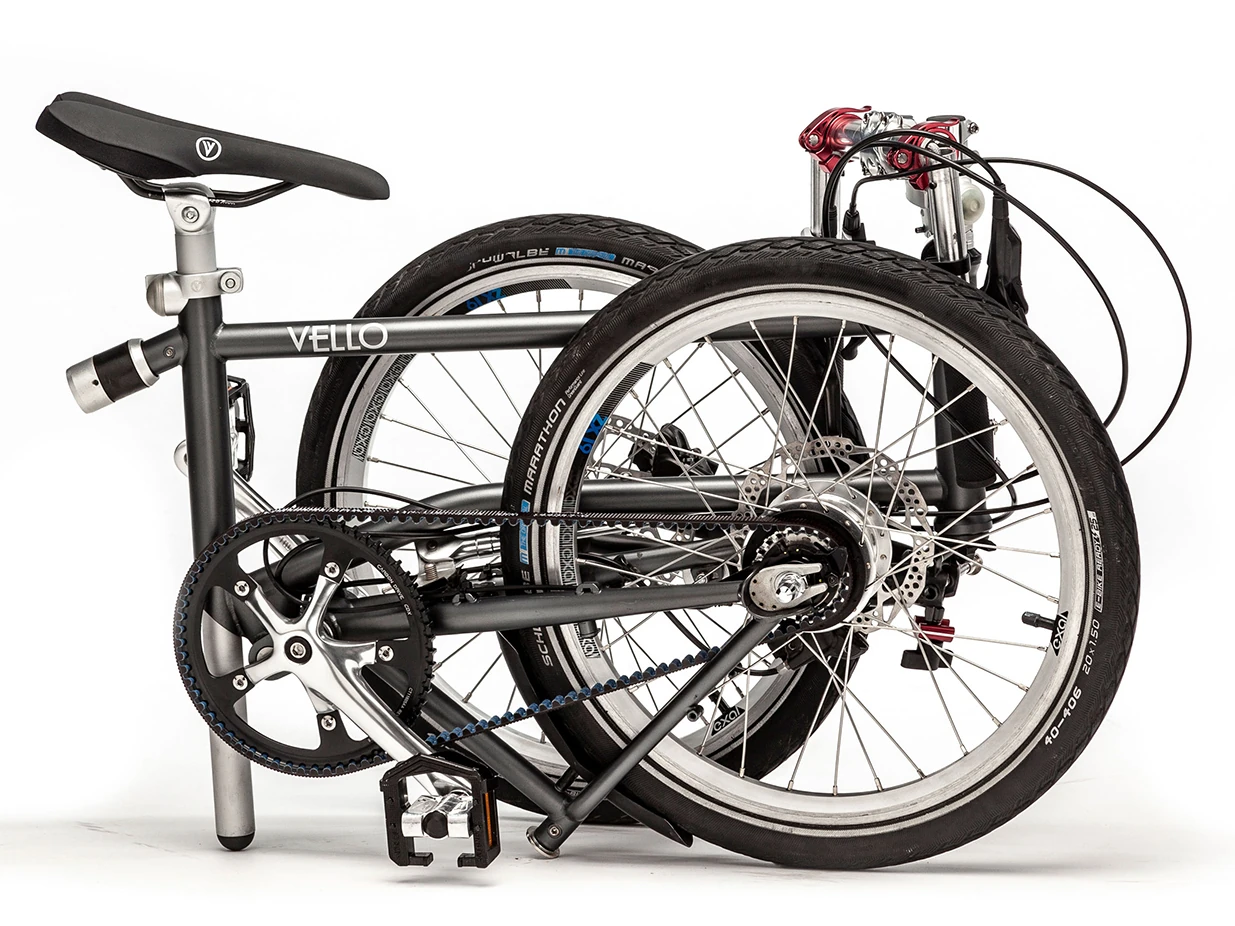
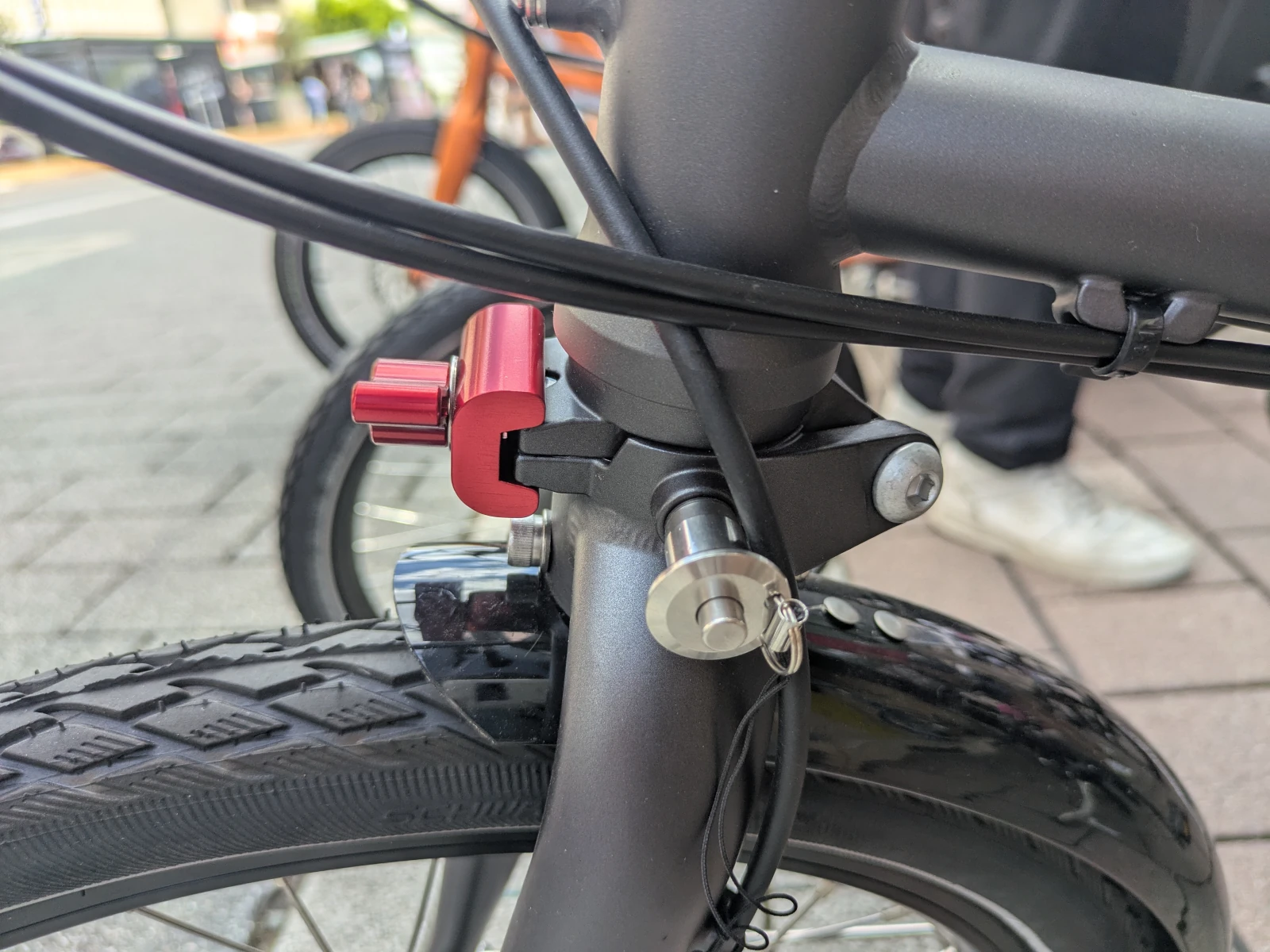
While the Vello folding bike is by no means a new product (around 10 years old at this point), its folding mechanism is interesting and warrants some discussion. Unlike most folding bikes, there are no hinges in the frame, thereby reducing weight (or increasing strength). Instead, the bike features a foldable fork, for which Vello has a patent. To prevent the wheel from folding under in case the hinge clamp is not done up properly, a pin is used to provide additional security.[9][9]: Someone at the stand mentioned to me that this safeguard is required by law, but wasn’t able to tell me which law this might be. The rear folding mechanism is also noteworthy, as the rear wheel folds under the frame slightly off to the side, to make room for the front wheel. This is due to the corresponding folding axis being non-perpendicular to the direction of travel. Despite the interesting folding mechanism, it must be pointed out that the Vello is far from the most compact fold. Furthermore, the handlebar folding mechanism seems a little inelegant.
3 Light electric vehicles and velomobiles
3.1 Hopper
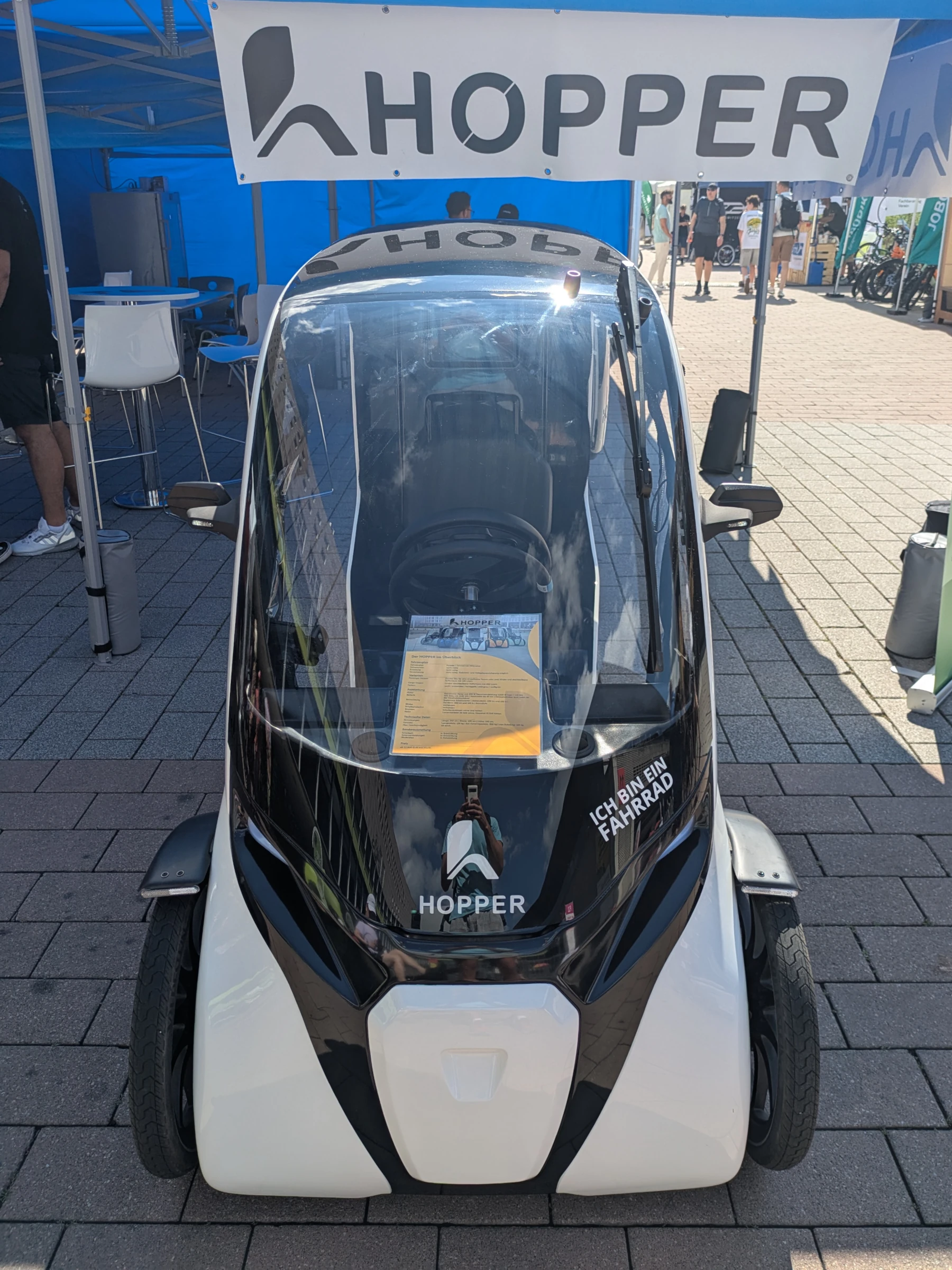
The Hopper is an enclosed reverse tricycle with rear wheel steering that I have seen at the Eurobike previously. It is also the name of the company that designed and manufactures the Hopper. Hopper is located in Hamburg and currently has 11 employees. They were at the Eurobike for the 5th time this year. The drive system is a series hybrid or pedal-by-wire, as the company calls it, meaning the human power is first converted to electricity via a generator, and later put to the wheels via the motor. While this configuration is very low maintenance and enables stepless gearing, its efficiency is rather low compared to parallel hybrid solutions. I really like the Hopper’s rear wheel steering, which greatly increases the vehicle’s cornering stability compared to front wheel steering.[10][10]: Most enclosed human powered tricycles or quadricycles suffer from poor cornering stability, unless they are very low profile, such as velomobiles.
3.2 Sunnyclist
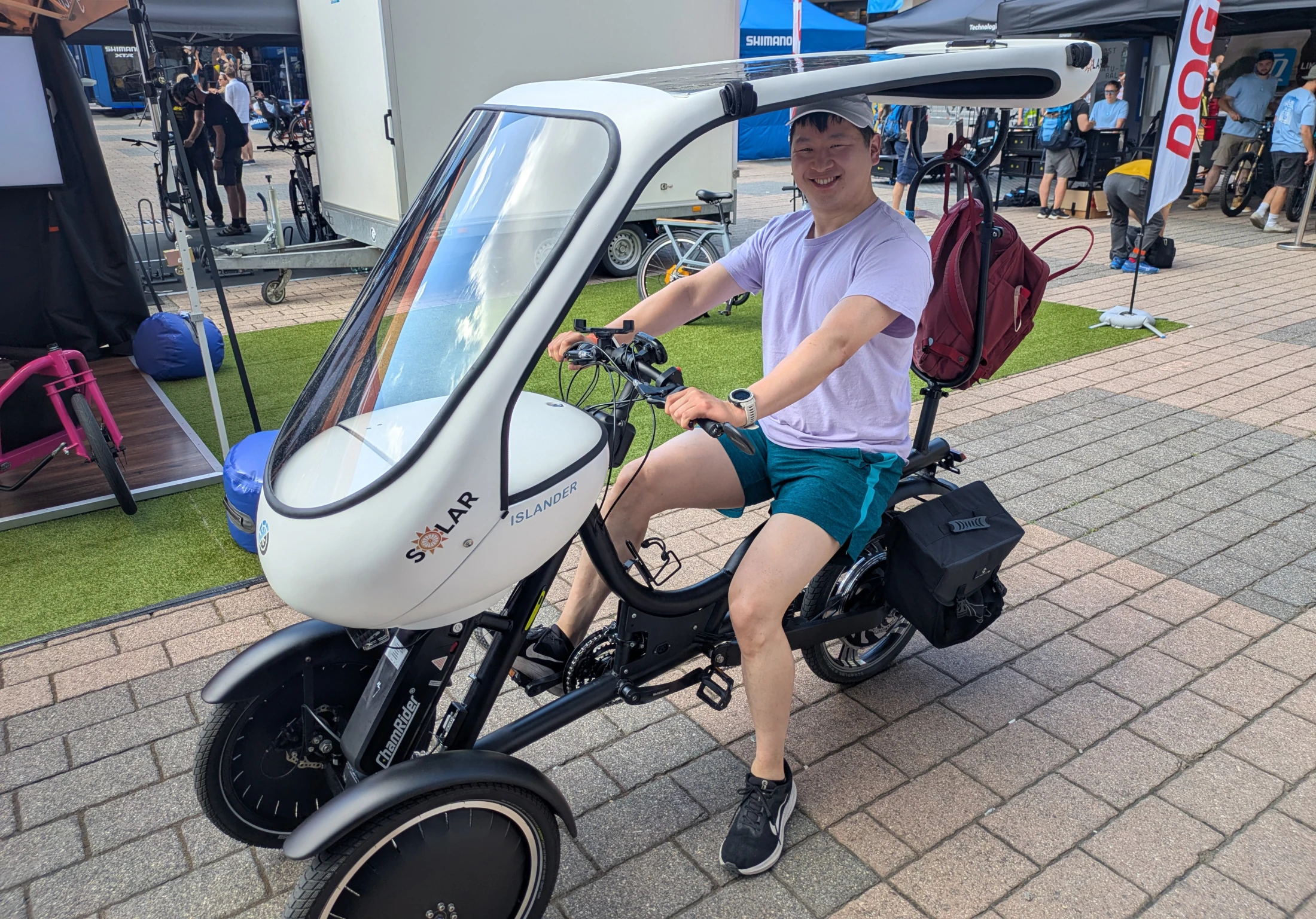
The Sunnyclist is a solar powered tilting reverse tricycle. It was developed by a Greek gentleman by the name of Manolis Tsikandilakis and is manufactured in Crete. Especially in sunny places such as Crete, combining solar power generation with human power makes perfect sense, and I am surprised I haven’t yet seen more examples of this. The Sunnyclist features a walking assist, and its tilting mechanism can be locked when stationary to avoid the tricycle falling over. It also has electrical power connectors, allowing external appliances to be powered by its battery (and solar array).
The Sunnyclist was great fun to ride, however at low speeds it felt rather unstable. I was also not a big fan of the speed based electric assist, and at higher levels of human power the electric assist seemed to cut out. Despite the walking assist, it is easily noticeable how heavy the vehicle is. Overall, the experience seemed a little unrefined, but there is definitely a lot of potential.
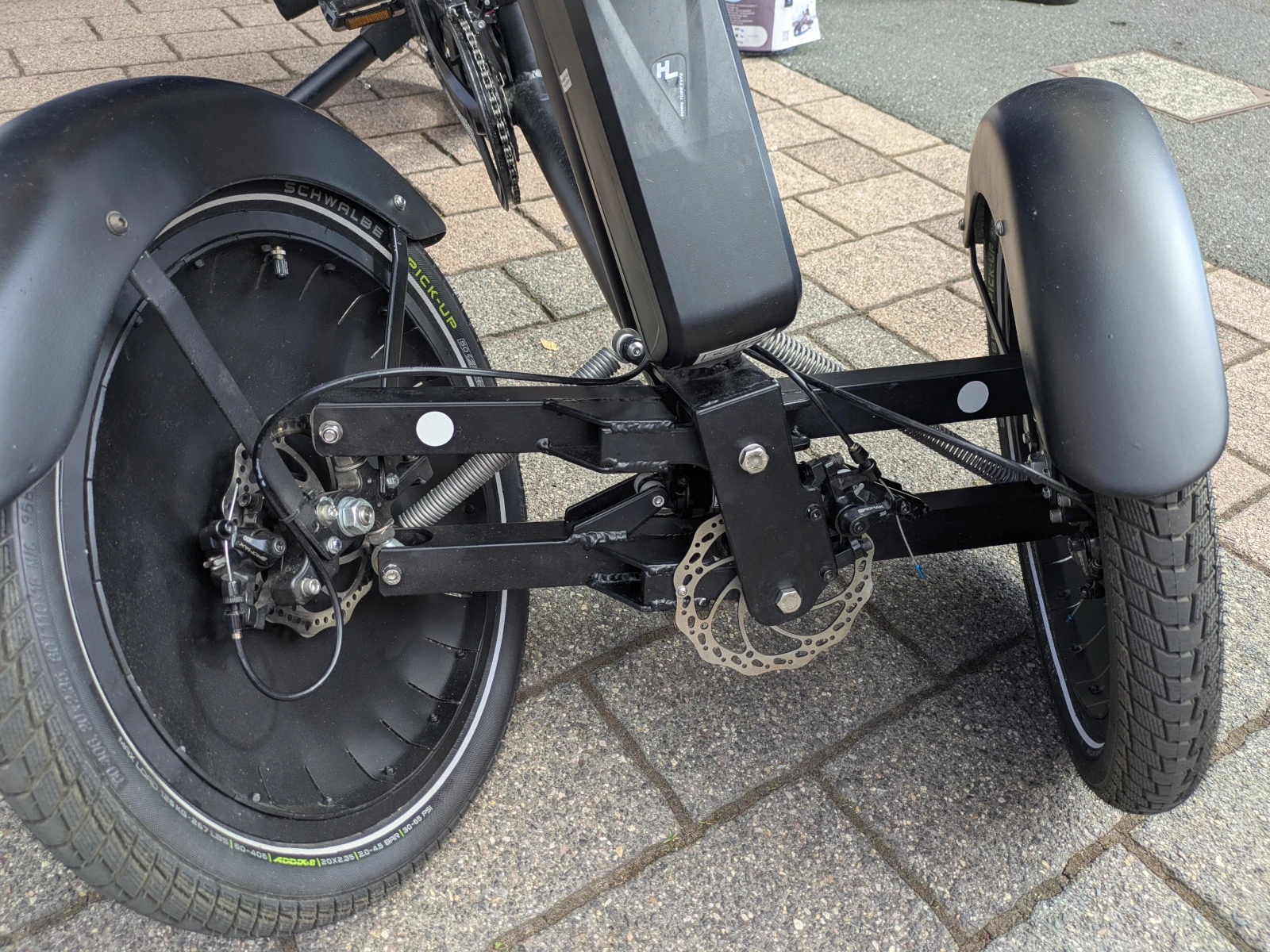
One curiosity of the design are the front wheels. These appear to comprised of a stamped concave aluminium disc. The reason for this design is to minimise forces on the steering mechanism as a result of braking. The closer a wheel’s steering axis is to the wheel’s plane, the smaller the moment about the steering axis when braking. A bicycle doesn’t suffer this problem, because the fork’s axis of rotation concides with the wheel’s plane.
3.3 Envo
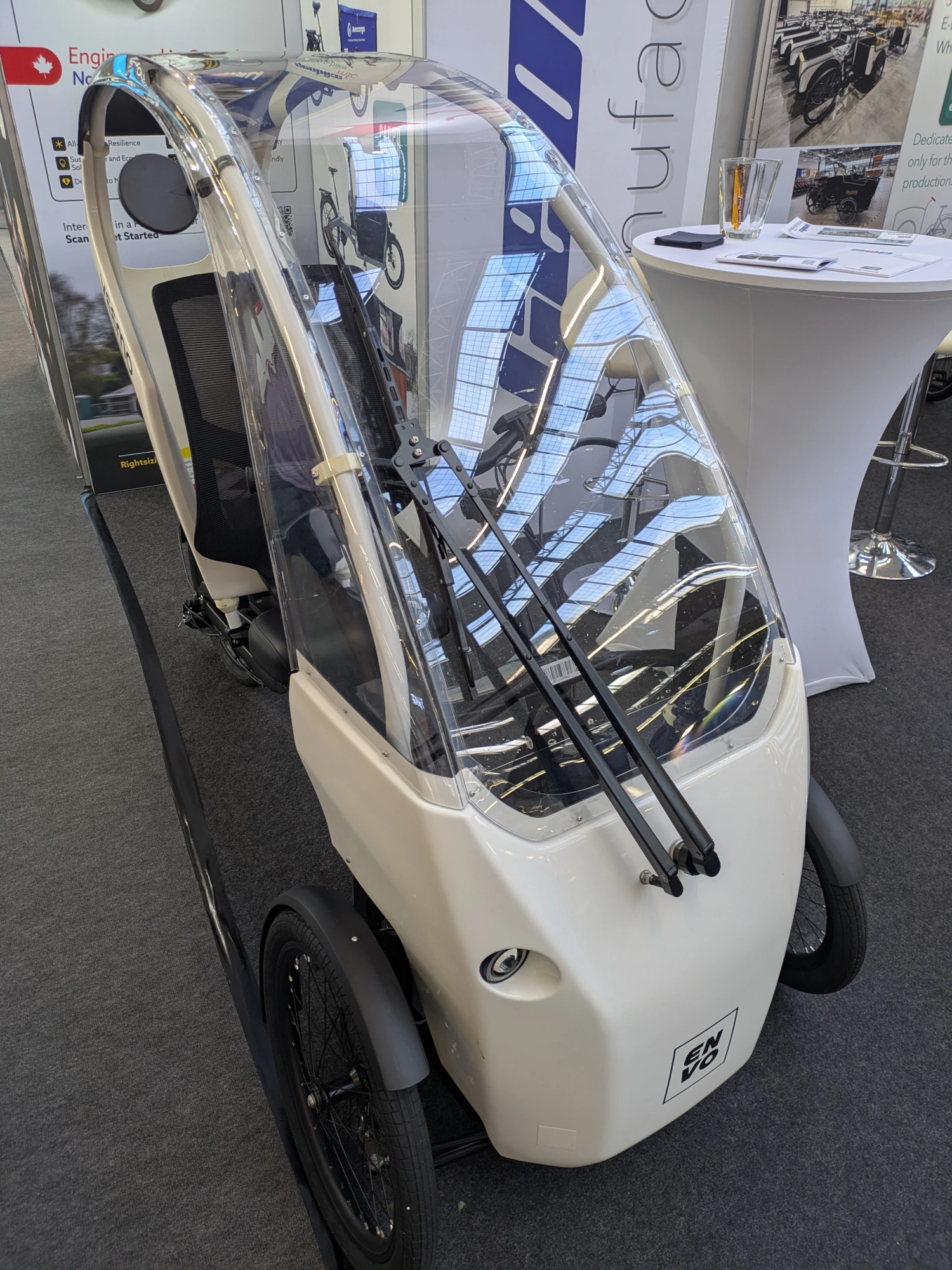
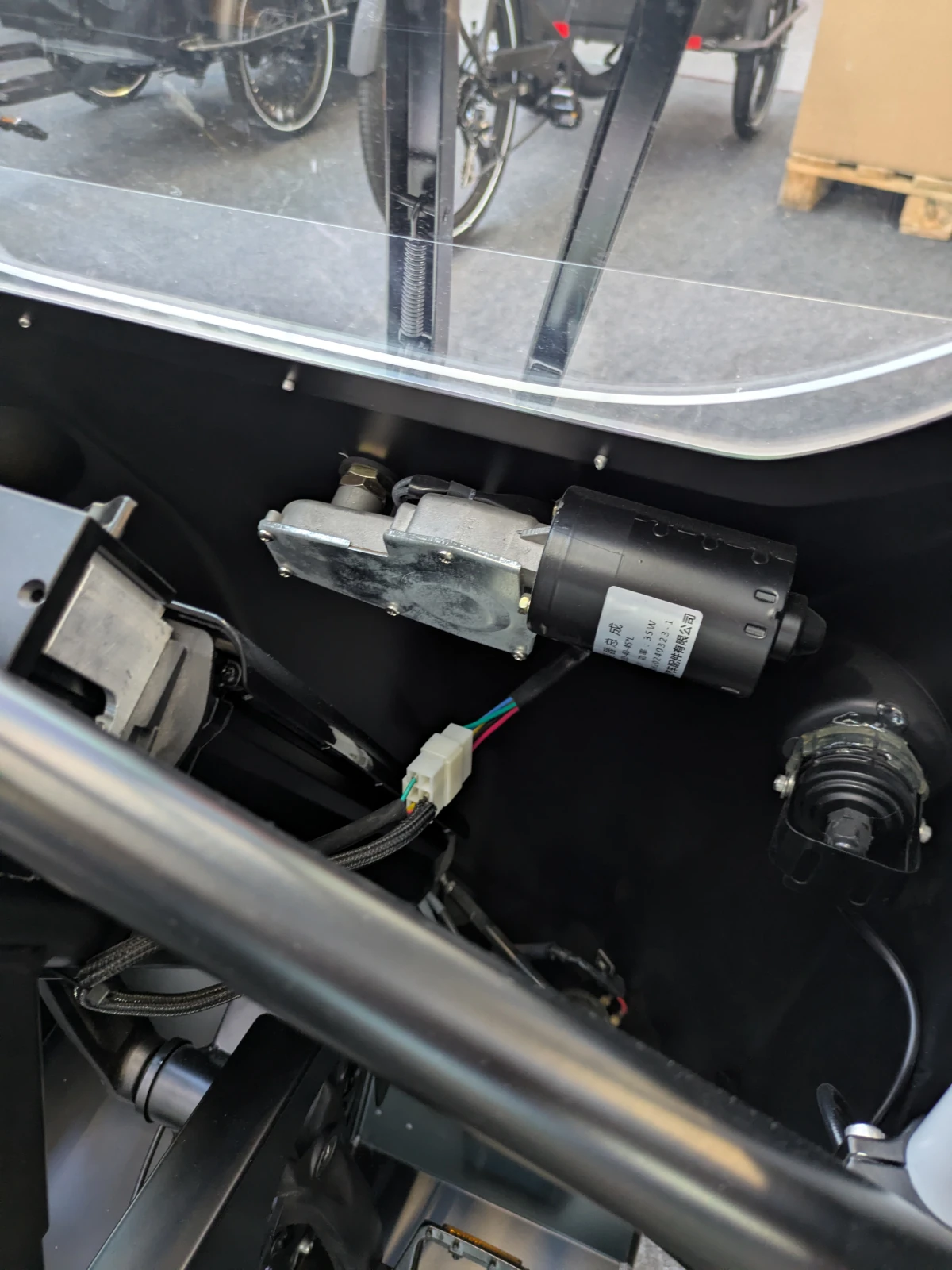
The Envo is a Canadian enclosed reverse tricycle design. It appears the Envo was previously called Veemo, but was acquired by ENVO Drive Systems, who are based in Vancouver. It is manufactured under contract in Szeczin, Poland for the European market. I was intrigued by the Envo because of its prominent windscreen wipers and its cost effective design.
3.4 CIXI Vigoz
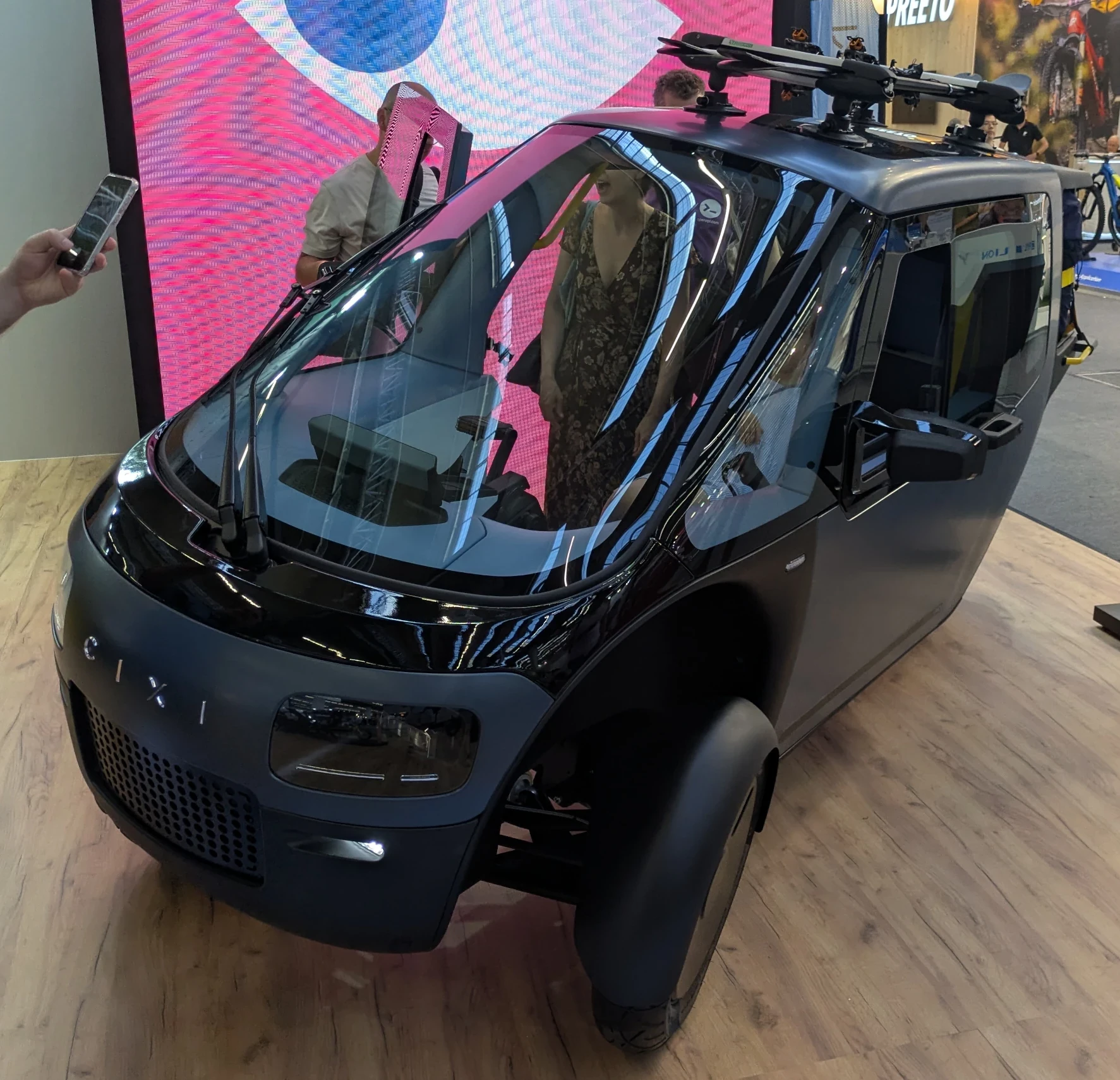
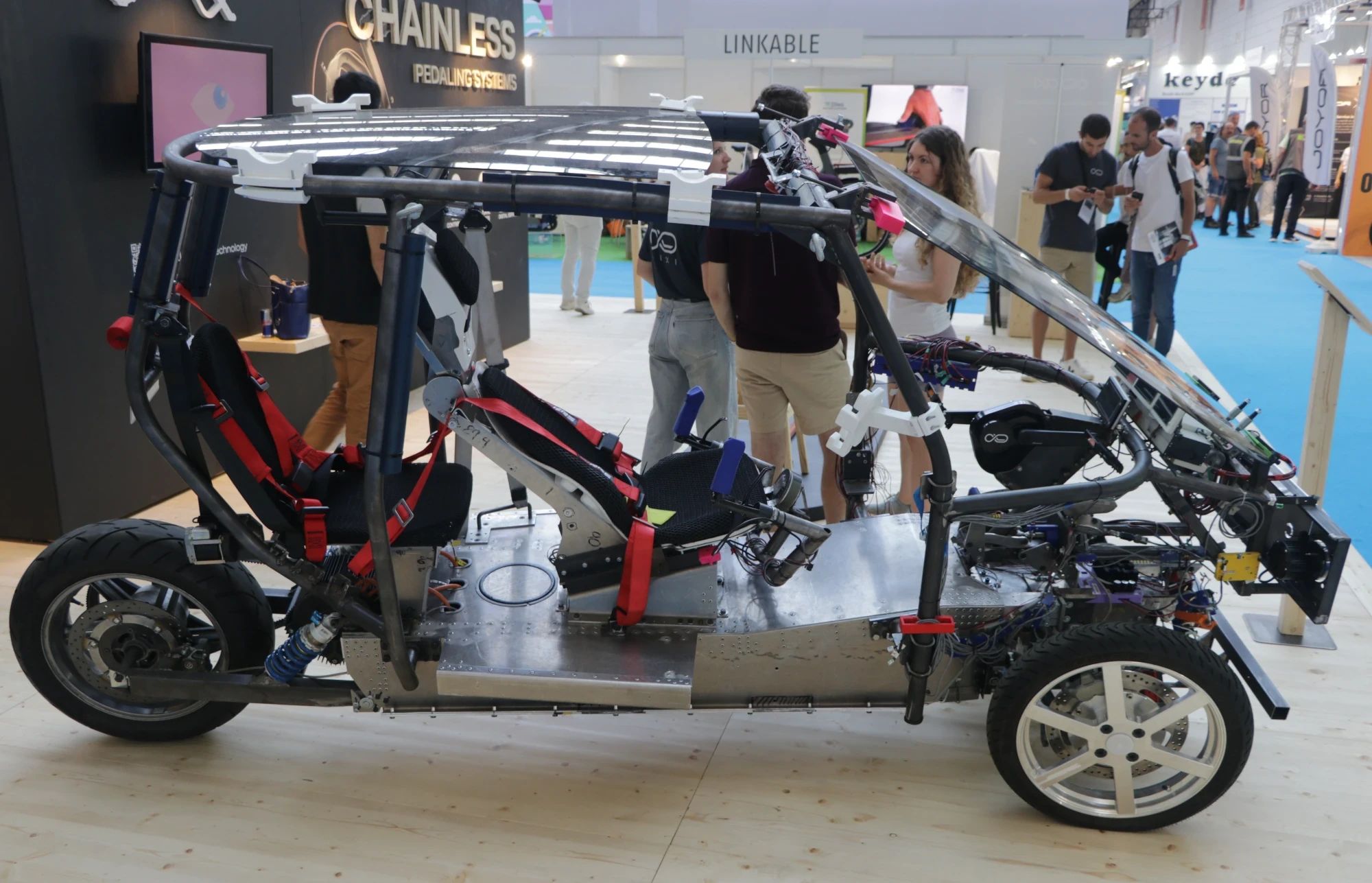
CIXI is an innovative company based in Annecy, France, at the foot of the French Alps. They developed a chainless drivetrain (a generator and motor), which was presented at the Eurobike 2023. In 2023, they also showcased a prototype electric human powered vehicle, shown in Fig. 18. It seems this prototype has been substantially refined over the last two years, and has turned into a rather aesthetically pleasing design, which they call Vigoz. The Vigoz belongs to the L5 vehicle category and can travel at speeds of up to 120 km/h. At these sorts of speeds I suspect the fraction of human power to total power consumption will be very low, given the Vigoz’s aerodynamic design is significantly more draggy then a typical velomobile. Nonetheless, it’s really great to see human power being integrated into higher speed light electric vehicles!
4 Drive systems, gear boxes, and other innovative components
4.1 Villiger Dynamic’s Dynamic Drive
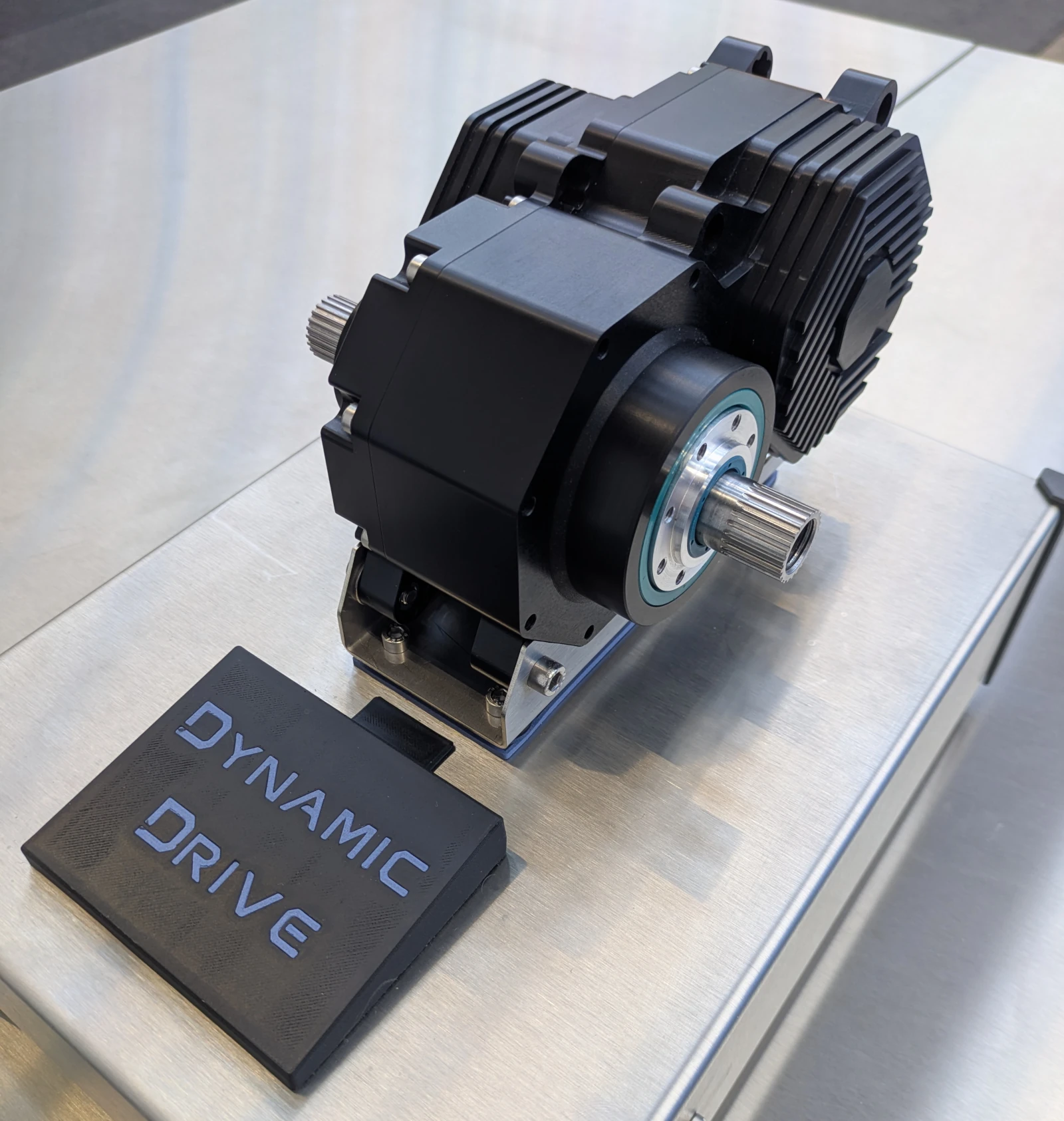
Villiger Dynamic is a Swiss company spun out from Villiger Technik, another Swiss company selling an eclectic mix of industrial products including horse manure suction systems.[11][11]: Both companies have presumably been founded by Bruno Villiger, a Swiss gentleman who I got to chat to at the Eurobike. Villiger Dynamic are developing a mid drive motor with an integrated stepless transmission.
This type of transmission/drive system is not new and has been attempted before, both by the now defunct Finnish company Revonte, and Driven Technologies, a company spun out of CeramicSpeed, who are developing the Orbit Drive. Revonte seems to have come quite far along the development process before they filed for bankruptcy in 2023 due to lack of further investment, after raising €2MM in a seed round in 2019. Driven raised $1MM in crowd funding in 2021, and presented a prototype of their technology at the Eurobike 2023. Since then I haven’t heard any updates, but the business appears to be a going concern.
The working principle of this type of transmission/drive system is explained by Driven’s Ryan Norris in this video from the Eurobike 2023. It is similar to an automotive power-split or series-parallel hybrid system. The first electric motor, the torque motor, is directly coupled to the output shaft, and the second (the speed motor) to the input via a differential gearbox. By changing speed, the speed motor is thus able to change the ratio of input to output speed. If the speed motor is constrained to spin in one direction only (e.g. via a sprag clutch), then the minimum gear ratio occurs when the speed motor doesn’t spin. For higher gear ratios without net electrical power input, the torque motor has to act as a generator. However, it seems the Dynamic Drive is able to perform a controlled start from standstill, which requires the speed motor to be able to spin backwards. Apparently, the Dynamic Drive can also reverse the direction of the output while the input continues to spin in the same direction (which could be used to reverse a cargo bike without changing pedalling direction for example[12][12]: This seems pointless to me, as it would be more intuitive to reverse by pedalling backwards, which would also be much more efficient with this setup.). This requires the speed motor to act as a generator, absorbing all of the human power as well as some of the power generated by the torque motor, and the torque motor to provide all of the output power, plus the power that is flowing into the speed motor. A challenge with this kind of setup is the speed motor’s ability to resist the rider’s torque. From discussions with Bruno, it seems they may have found an (electro-)mechanical solution to this, although he didn’t want to provide any details for obvious reasons.
While this kind of transmission is certainly intriguing, it is not the most efficient. Peak efficiency is reached when neither motor acts as a generator, which happens at a fairly low gear when the speed motor doesn’t spin. At this gear ratio, the efficiency is simply the combined mechanical efficiency of the gears and belt. The further the system diverges from this gear ratio, the closer the efficiency comes to that of a pure series hybrid system, like the one CIXI or Hopper are using (generator plus motor). The efficiency of such a system typically doesn’t exceed 70%. Therefore, at high gear ratios, I wouldn’t expect the Dynamic Drive’s efficiency to exceed 75 – 80%, placing it in a similar category as the Enviolo, though unlike the Enviolo, it includes integrated electric propulsion.
I think Villiger Dynamic’s drive system has a better chance of succeeding than its predecessors, especially since there seems to be no risk of impending bankruptcy, provided Villiger Technik continues to sell horse manure suction systems.
4.2 Contavelo
The Contavelo is a new two speed gear box that is integrated in the crank. The Contavelo’s obvious competitor is the Schlumpf Drive, which wasn’t present at the Eurobike this year. Unlike the Schlumpf Drive, one shifts via backpedalling rather than with one’s heel, which is probably more intuitive. Also unlike the Schlumpf drive, the mechanism does not feature a planetary gear box. Instead, the reduction gear uses a type of cycloidal gear speed reducer with a gear ratio of 4:3. The shifting mechanism is also quite clever and relies on two sets of pawls, the outermost ones being retracted or extended when one backpedals, facilitating the gear shift. The mechanism can be examined in this video.
4.3 Enviolo
The Enviolo is an interesting continuously variable gear hub that was once called NuVinci. After the Dutch company filed for bankruptcy in 2018, it was rebranded as Enviolo under new ownership. Enviolo have been on the Eurobike many times before, and the hub is mentioned here for completeness, as I have not previously written about it.
The mechanism consists of an input and output ring connected by a series of spheres, which themselves rotate about axes which may be tilted. The tilt of these axes determines the gear ratio. The input and output rings are coupled to the spheres by friction. The friction is provided by a non-Newtonian fluid, which becomes significantly more viscous under the contact pressure. Due to the lack of positive coupling, the Enviolo’s main energy loss mechanism is slippage. While the hub is not very efficient, it is well suited for electric bikes, where the efficiency doesn’t matter so much. The stepless shifts make for a great riding experience.
4.4 3x3
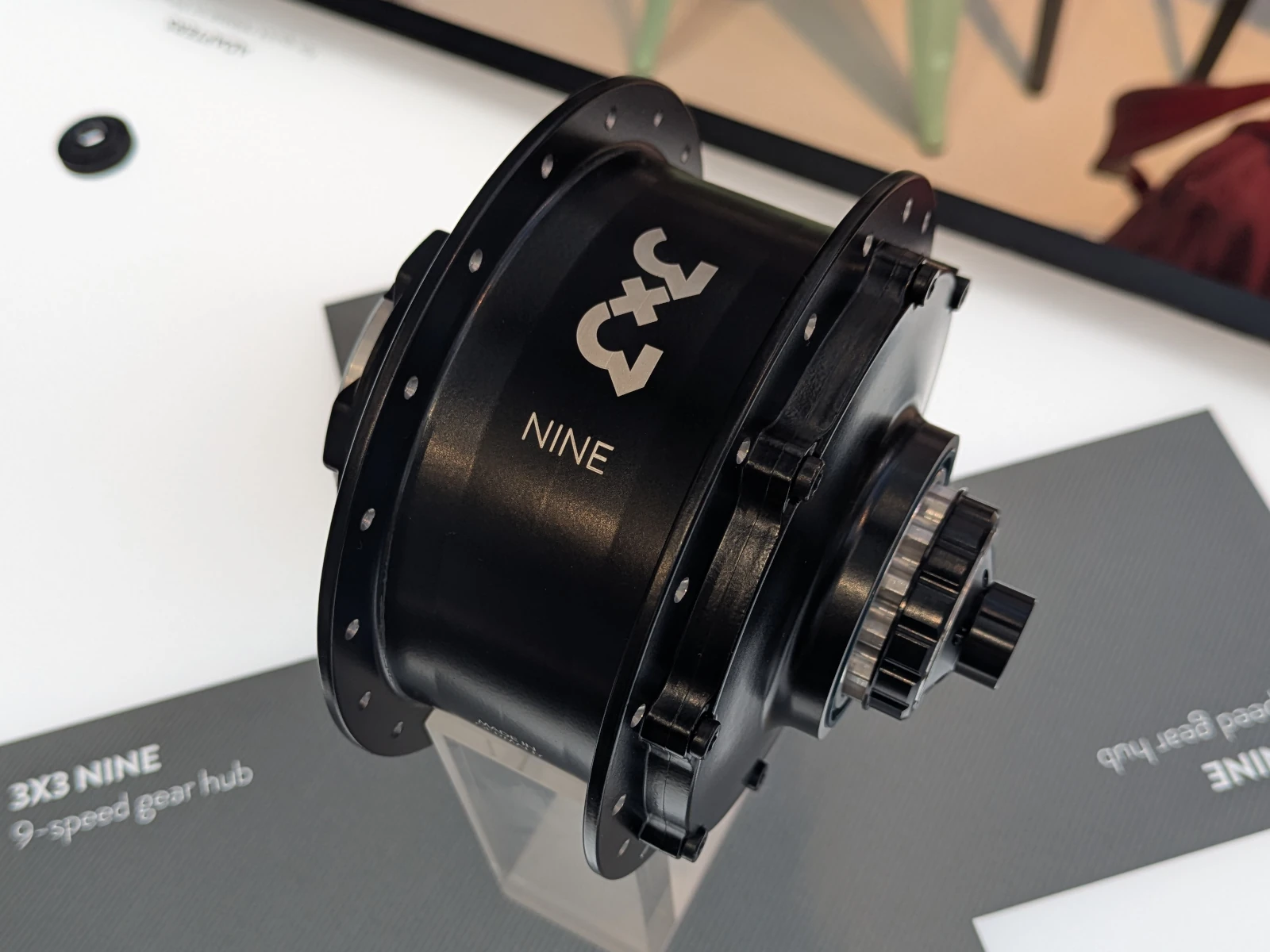
The 3x3 is a 9-speed gear hub that was released in 2022. It is manufactured by H+B Hightech GmbH, a German automobile supplier specialising in camshafts. The company developed the gear hub as a diversification effort in order to survive the imminent collapse of the German automobile supply sector. The project was apparently inspired by the CEO of Nicolai Bicycles, Kalle Nicolai, who wanted to make a new gear hub but didn’t have the time, and had connections to H+B Hightech GmbH.
The hub has gear steps of 24% and an overall gear ratio of 554%. According to tests by 3x3, the hub is 19% more efficient than the Enviolo. Enviolo claims that their hub is around 85% efficient, which would make the 3x3 101% efficient, so someone must be inflating their numbers.[13][13]: I suspect it’s Enviolo.
4.5 Sidekick
The sidekick is a new hub that was released towards the end of last year. It eliminates kickback when descending through rough terrain on a mountain bike by introducing a dead band of a couple of degrees before the rear hub is engaged when the rider starts pedalling. This is accomplished by a very clever double pawl mechanism, which is best explained by this animated image. I could also see how this would be useful for regular bicycles, because it significantly reduces the noise made by the pawls when freewheeling.[14][14]: Only one pawl makes contact with the hub during freewheeling, and that pawl can be much lighter and therefore quieter, because it doesn’t need to resist the driver’s torque. When pedalling, the rider’s torque is transferred by the other three pawls which are retracted during freewheeling.

5 Miscellaneous
5.1 Holland Mechanics Robot OT

At this Eurobike I got to chat to Pawel Stasiewski, an engineer at Holland Mechanics. He demonstrated the operation of the Robot OT, Holland Mechanic’s top-of-the-line wheel truing machine. Unlike other truing machines, the OT performs spoke tension measurements during the truing process — other truing machines simply true wheels by varying the maximum torque applied to the nipples, and only ever tighten nipples during the truing process, unlike the OT, which loosens nipples as well. Apparently, a torque-based approach is good enough for most applications. As a result, the OT can achieve spoke tension tolerances of less than 10%, whereas the traditional approach results in tolerances of up to 40%. On the other hand, the OT takes around 8-10 minutes to true a wheel, whereas the less sophisticated machines achieve this in 40 seconds. It seemed to me that there was significant scope for optimisation of the OT’s truing process though. Unfortunately, there is currently no incentive for Holland Mechanics to improve the OT’s speed, as this machine is the only bicycle wheel truing machine on the market capable of spoke tension measurements.
The OT is also capable of truing wheels with carbon spokes. These spokes need to have a square section close to the rim[15][15]: Which, as Pawel pointed out, needs to be precisely aligned during manufacturing of the spoke., which the machine grabs before it twists the nipples, to avoid any torque being transferred to the spoke (carbon spokes don’t like to be twisted). As I learned later when chatting to a Taiwanese gentleman from Pillar Spokes, Holland Mechanics have a patent on the use of this square section. That’s pretty clever, since a spoke needs to have this square section, otherwise it won’t be compatible with Holland Mechanics’ wheel truing machines!
5.2 Kilian Weigand’s solar powered tricycle
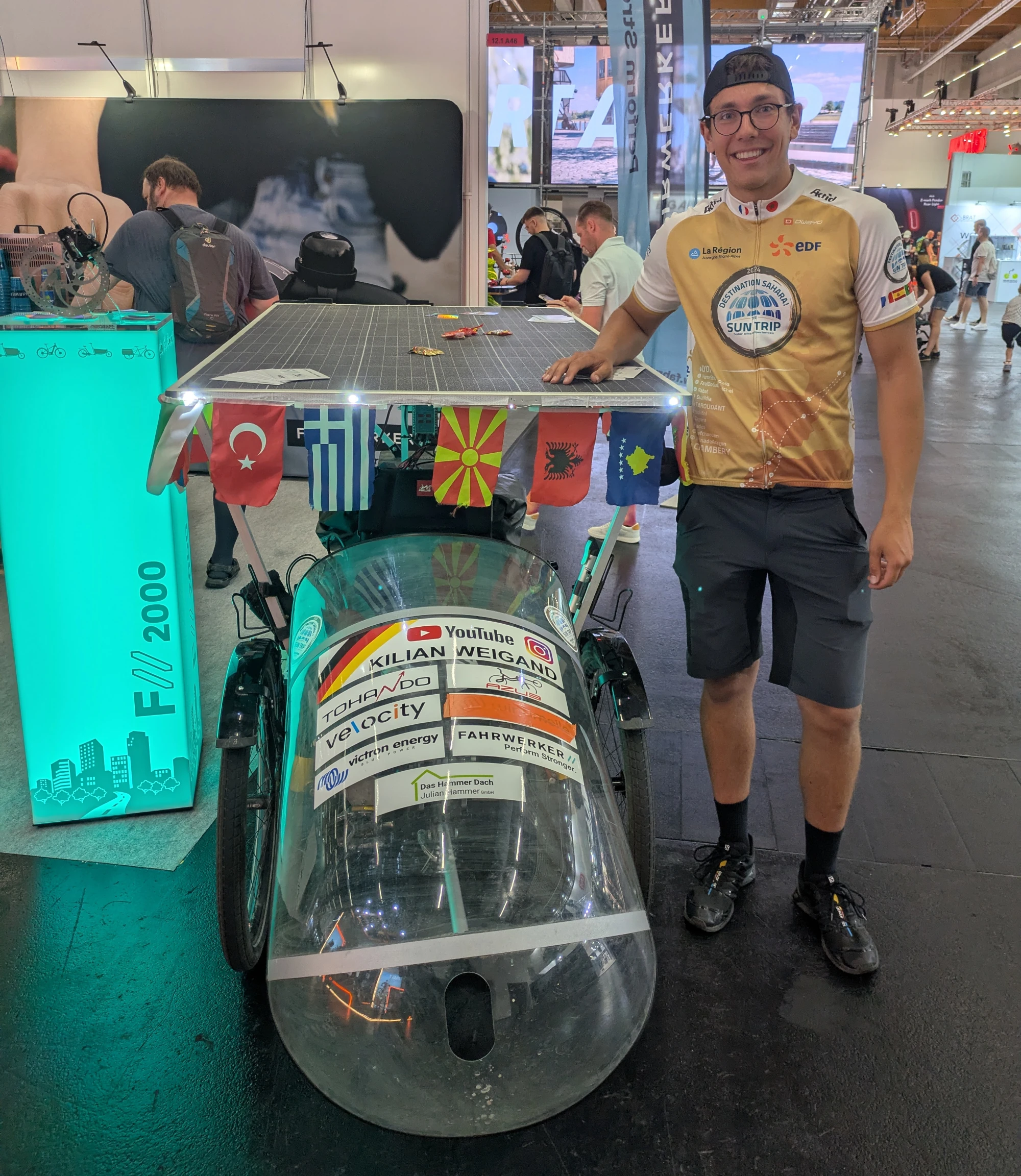
The Sunnyclist was not the only solar powered vehicle at the Eurobike 2025. Kilian Weigand was at the Fahrwerker stand[16][16]: Fahrwerker make robust brakes for cargo bikes, amongst other things. and presented his homebuilt solar powered tricycle. Kilian has previously participated in a 7,500 km solar bike race across the Sahara. You can find out more about his adventures on his YouTube channel.